

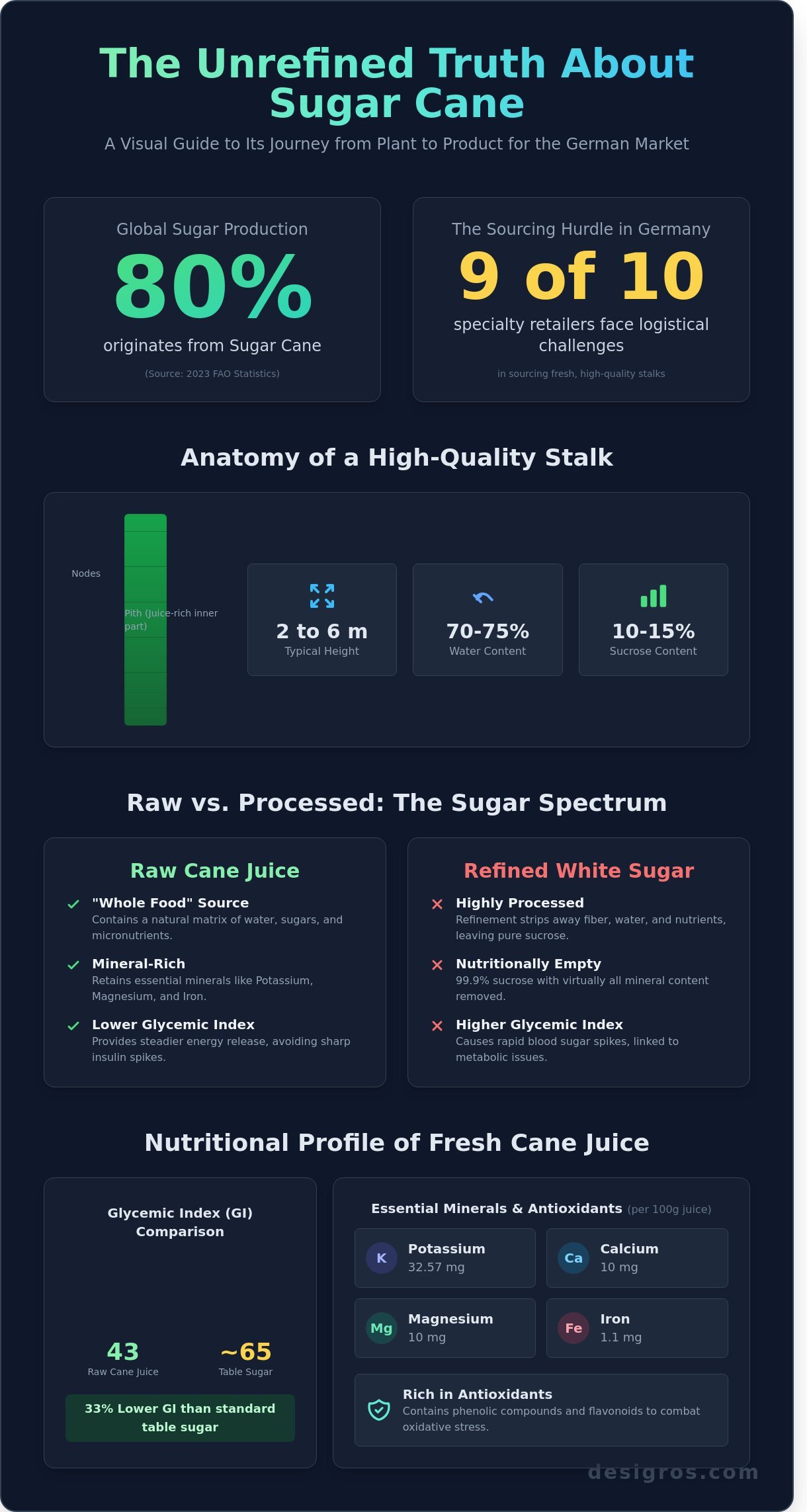
While 80% of the world's sugar production originates from sugar cane, sourcing fresh, high-quality stalks in Germany remains a significant logistical hurdle for 9 out of 10 specialty retailers. You likely recognize that the gap between processed white sugar and raw, mineral-rich cane is vast, but high shipping costs and fragile supply chains often make stocking fresh produce feel like a financial risk. Most businesses struggle to find a balance between quality and cost when importing heavy stalks across borders, leading to wasted capital on damaged inventory or unreliable delivery timelines.
This guide provides a professional roadmap to sourcing fresh stalks and traditional products directly within the German market. You'll learn the specific nutritional advantages of raw juice, efficient home and commercial preparation techniques, and how to identify a supplier that offers wholesale pricing in Euro. We're moving past the confusion of refined products to help you secure a stable, high-volume supply for your kitchen or retail shelves. By the end of this article, you'll have the data needed to optimize your inventory and provide your customers with authentic, raw products without the overhead of international shipping stress.
Key Takeaways
- Understand the biological structure and the nutrient-dense profile of sugar cane, including its essential minerals and low glycemic index.
- Learn professional methods for selecting the freshest stalks and the specific tools required for efficient preparation at home or in a commercial kitchen.
- Navigate the complexities of the German import market to identify reliable local sources for high-quality tropical produce.
- Explore how businesses can leverage wholesale partnerships to ensure a consistent supply of authentic South Asian products for the food service industry.
- Gain insights into the logistical advantages of B2B sourcing to optimize inventory and profitability for juice bar startups and restaurants in Germany.
What is Sugar Cane? Understanding the World’s Primary Sugar Source
Sugar cane isn't just a plant; it's the foundation of the global sweetener industry. Scientifically classified as Saccharum officinarum, this perennial grass accounts for approximately 80% of the world's sugar production according to 2023 FAO statistics. To grasp its commercial value, one must first ask What is Sugar Cane? at a biological level. It's a high-biomass crop that stores energy as sucrose within its fibrous stalks. These stalks can reach heights of 2 to 6 meters, consisting of distinct nodes and internodes. The inner part, known as the pith, contains the juice-rich parenchyma cells that businesses harvest for extraction.
For retailers and gastronomy professionals in Germany, understanding the anatomy of the plant is vital for quality control. A high-quality stalk should be heavy for its size, indicating a water content of roughly 70% to 75%. The sucrose content typically ranges between 10% and 15% in mature plants. In South Asian and tropical cultures, fresh sugar cane is a dietary staple because it provides immediate glucose and essential electrolytes. It's often consumed raw by peeling the bark and chewing the pith or by pressing the stalks through industrial rollers to create "Gannay ka Ras" or fresh cane juice.
The Botanical Origins and Varieties
Cultivation began over 4,000 years ago in New Guinea before spreading to the Indian subcontinent. Today, commercial growers distinguish between "Noble canes," which have high sugar levels and low fiber, and modern hybrids designed for disease resistance. Climate dictates the yield; the plant requires at least 1,500mm of annual rainfall or equivalent irrigation. In Germany, fresh imports usually arrive from regions like Vietnam or Egypt, where the specific soil pH levels of 5.0 to 8.0 produce the sweetest profiles. Variations in stalk color, from deep purple to pale green, often indicate different fiber-to-juice ratios.
Raw vs. Processed: The Sugar Spectrum
The transition from raw stalk to white crystals involves several stages of refinement that strip away nutritional value. Raw cane juice is a "whole food" containing traces of potassium, magnesium, and iron. When this juice is boiled and solidified without removing the molasses, it becomes jaggery or gur. This unrefined product is a key SKU for ethnic grocery stores in Berlin and Frankfurt. In contrast, refined white sugar is 99.9% sucrose, processed through centrifugation and carbonatation to remove all mineral content.
The industry also relies on the by-products of sugar cane processing to maintain profitability. Once the juice is extracted, the remaining crushed fiber, called bagasse, is often repurposed as biofuel or eco-friendly packaging material. Molasses, the thick syrup left after sugar crystallization, serves as a base for rum production and animal feed. For German businesses, sourcing fresh stalks means tapping into a market that values the raw, enzymatic properties of the plant which are completely absent in processed tabletop sugars. Freshness is the primary metric; stalks start losing sucrose content within 24 hours of being cut, making efficient logistics and cold-chain management essential for the European market.
The Nutritional Profile and Health Benefits of Sugar Cane
Fresh sugar cane is a nutrient-dense raw material that differs significantly from the refined white sugar found on most German retail shelves. While industrial processing strips away vitamins and minerals, the raw plant retains a complex matrix of essential micronutrients. Analysis shows that 100 grams of fresh juice contains approximately 32.57 mg of potassium, 10 mg of calcium, 10 mg of magnesium, and 1.1 mg of iron. These minerals are vital for bone density and cardiovascular function. Understanding the World’s Primary Sugar Source helps clarify how the plant stores these elements within its fibrous stalks during its 12 to 18 month growth cycle. Because the juice is unrefined, it maintains a lower Glycemic Index (GI) of 43, which is 33% lower than standard table sugar. This lower GI profile means the body processes the energy more steadily, avoiding the sharp insulin spikes common with processed sweets.
The presence of antioxidants further enhances its profile. Raw sugar cane contains high concentrations of phenolic compounds and flavonoids. These substances support the immune system by neutralizing free radicals and reducing oxidative stress within the body. In a commercial context, offering fresh juice or stalks provides customers with a functional beverage option rather than just a sweetener. It's an effective natural electrolyte source. The liquid contains a balance of salts and water that facilitates rapid recovery after physical exertion. This makes it a viable alternative to synthetic sports drinks that often contain artificial dyes and preservatives.
A Natural Energy Booster
The sucrose found in raw juice provides a direct glucose supply that the body converts into immediate energy. In traditional Indian agriculture, laborers have relied on this for decades as a primary source of fuel during 10 hour work shifts. It's a functional "sports drink" that replaces lost minerals through sweat. This natural beverage serves as a critical tool for rapid rehydration and temperature regulation during the peak summer months in tropical climates.
Digestive and Liver Health
Ayurvedic medicine has utilized sugar cane juice for centuries to support liver function and manage conditions like jaundice. The juice is naturally alkaline, which helps maintain the body's pH balance and soothe the digestive tract. Chewing on the raw stalks provides a mechanical cleaning action for the teeth while delivering roughly 0.5 grams of dietary fiber per serving. This fiber promotes gut motility and supports oral hygiene by strengthening the gums through the chewing process. For businesses looking to source this versatile product in bulk, checking the current wholesale availability ensures a steady supply for health-conscious consumers.
- Potassium: Supports heart health and blood pressure regulation.
- Magnesium: Essential for over 300 biochemical reactions in the human body.
- Alkalinity: Helps neutralize excess stomach acid and prevents indigestion.
- Phenolic Compounds: Provide anti-inflammatory benefits and support cellular repair.
For the German market, where consumer interest in "clean label" products is rising, the transparency of sugar cane's nutritional profile is a strong selling point. It isn't just a source of calories; it's a source of hydration and mineral replenishment. B2B buyers should note that the quality of these nutrients depends heavily on the freshness of the stalks. Once harvested, the sucrose levels and mineral stability remain high for several days if stored at temperatures between 5°C and 8°C. This stability allows for efficient logistics and distribution across European supply chains without compromising the health benefits that drive modern consumer demand.
How to Prepare and Enjoy Fresh Sugar Cane at Home
Selecting high-quality sugar cane requires attention to physical density and surface integrity. A premium stalk feels heavy for its size, which indicates high water and sucrose content. You should look for skin that is smooth and vibrant; yellow varieties should be bright, while purple ones should be deep and consistent. Avoid any pieces with vertical cracks or red discolorations on the ends. These flaws suggest a 20% reduction in juice yield due to evaporation or early-stage fermentation. In German specialty markets, stalks are often sold in 1-meter lengths, retailing between €4.50 and €7.00 per piece depending on the season and origin.
To process the stalks effectively, you need a 2.5mm thick stainless steel cleaver or a specialized sugar cane peeler. Standard vegetable peelers lack the structural integrity to pierce the fibrous rind. The traditional way to enjoy sugar cane involves chewing the internal pith. You bite into a small piece, masticate to extract the juice, and then discard the woody fiber known as bagasse. This method provides the most direct flavor profile and is common in 80% of households in tropical regions where the plant is a staple.
Proper storage is vital to prevent the 15% sugar concentration loss that occurs when stalks dry out. If you don't plan to use the sugar cane immediately, wrap the ends in damp paper towels and seal the entire stalk in plastic wrap. Store it in a refrigerator at a constant temperature of 4°C to 7°C. Under these conditions, the stalks maintain their moisture and sweetness for up to 21 days. If the cane develops a sour smell or the internal flesh turns orange, it's no longer safe for consumption.
Peeling and Cutting for Beginners
Success begins with cleanliness and the right dimensions. Follow these three steps for efficient preparation:
- Step 1: Scrub the stalks under cold running water with a stiff brush to remove soil and natural wax.
- Step 2: Use your cleaver to cut the stalk into manageable 10-15 cm sections. Make these cuts between the nodes, as the joints are significantly harder to penetrate.
- Step 3: Stand each section upright on a stable cutting board. Carefully shave off the hard outer green skin using downward strokes until the pale, fibrous interior is exposed.
Making Fresh Sugar Cane Juice Without a Press
You can extract juice at home using a high-powered blender with at least 1,200 watts of motor power. Chop the peeled pith into 1 cm cubes and pulse them with a small amount of filtered water to assist the blades. Once the mixture becomes a pulp, pour it through a fine-mesh nut milk bag or cheesecloth. Squeeze firmly to extract every drop of liquid. One meter of cane typically yields 250ml to 350ml of pure juice.
To replicate the classic Indian "Ganne ka Ras," add 5g of fresh ginger, 10ml of lime juice, and a few mint leaves to the blender. This combination balances the intense sweetness with acidity and heat. Safety is a priority here; you must consume the juice within 15 minutes of extraction. Rapid oxidation and microbial growth occur quickly at room temperature, which turns the juice dark and alters its nutritional profile. If you see the liquid changing from light green to brown, it's already losing its peak flavor.
Sourcing Fresh Sugar Cane and Products in Germany
Importing tropical produce like sugar cane into the German market requires navigating strict EU Regulation 2016/2031. This legislation mandates rigorous phytosanitary inspections to prevent the introduction of foreign pests. Because the stalks are highly perishable, importers must synchronize air freight schedules with customs clearance at major ports of entry. Frankfurt Airport (FRA) handles approximately 40% of Germany's air cargo, making it the primary gateway for fresh tropical goods. Speed is the most critical factor in this supply chain because the quality of the juice begins to degrade the moment the stalk is harvested.
Desigros maintains freshness by utilizing an optimized cold chain that keeps temperatures between 8°C and 12°C during transit. This specific temperature range is vital. It's high enough to prevent chilling injuries but low enough to stop the natural sugars from fermenting. Local Asian grocery stores serve as the main retail access points, typically receiving new shipments twice a week. These retailers prioritize high turnover rates to ensure customers receive stalks with maximum moisture content. In cities like Berlin and Hamburg, the demand for fresh stalks has increased by 15% over the last two years, driven by the rising popularity of cold-pressed juices.
Seasonal availability dictates the brix levels, or sugar content, of the product. While global trade allows for year-round sourcing, the peak quality for the German market occurs between November and April. During these months, harvests from major exporters like India and Thailand reach their maturity. Stalks purchased during this window are noticeably heavier and provide a higher juice yield compared to those harvested in the off-season. Buyers should look for firm, unblemished rinds to ensure they're getting the best possible product.
Online Delivery vs. Local Markets
Ordering heavy sugar cane stalks online is a practical solution for businesses that don't have direct access to wholesale markets in Berlin or Munich. Shipping these items requires specialized packaging, usually double-walled corrugated cardboard, to prevent the stalks from cracking. Most professional suppliers in Germany now offer 24 to 48-hour delivery windows to minimize juice loss, which can occur at a rate of 2% per day if stored improperly. This efficiency makes online sourcing a reliable alternative to visiting physical stores in major urban hubs.
Beyond the Stalk: Jaggery and Cane Syrups
Many consumers and professional kitchens look for processed alternatives like authentic Indian Jaggery (Gur). Finding high-quality, chemical-free versions in Germany requires checking for a light brown color and a moisture content below 5%. Darker shades often suggest over-processing or the presence of additives. You can explore our range of traditional sweeteners to find products that meet these strict quality standards. These items carry the standard 7% VAT for food products in Germany, making them a cost-effective staple for commercial baking and traditional confectionery.
Secure your supply of premium tropical ingredients today. Check our current stock and wholesale pricing at Desigros.
Why Desigros is Your Reliable Partner for Sugar Cane Products
Desigros functions as the primary bridge between South Asian agriculture and the German food industry. We've established a robust supply chain that moves fresh produce from source countries to our central distribution hub in Friedrichsdorf. This strategic location near Frankfurt allows us to reach 85% of German cities within 24 to 48 hours. We understand that for a juice bar or a restaurant, reliability isn't just a preference; it's a requirement for survival. Our procurement team focuses on authentic sourcing, ensuring that the stalks we import possess the high sucrose content necessary for premium juice production.
Every batch entering our warehouse undergoes a manual inspection process. We reject produce that shows signs of dehydration or bruising, maintaining a 98% quality approval rating across our fresh produce category. By working with verified farmers and premium brands, we eliminate the uncertainty often associated with importing tropical goods into Europe. Our operations are fully compliant with German food safety regulations, providing you with the documentation needed for your commercial business records. We don't just sell products; we provide a stable foundation for your supply chain.
B2B Solutions for German Businesses
Businesses in Berlin, Munich, and Hamburg rely on our scalable wholesale infrastructure. We provide bulk pricing for sugar cane stalks and jaggery blocks, allowing commercial clients to secure their profit margins. If you're running a high-volume juice bar, you'll find that our tiered discount system offers savings of up to 22% compared to standard retail prices. We maintain high stock levels even during peak demand periods, which prevents the inventory shortages that can ruin a weekend's revenue for a small business. Our logistics network handles the heavy lifting, delivering heavy crates directly to your commercial kitchen or storage area with precision.
- Bulk pricing: Tiered rates for stalks and 5kg jaggery blocks.
- Inventory stability: Real-time stock tracking to prevent menu disruptions.
- Direct delivery: National shipping covering all 16 German states.
The Desigros Advantage: Freshness and Variety
Desigros offers a unique "everything under one roof" solution. You don't need to manage five different suppliers for your ethnic grocery needs. You can buy your fresh produce alongside 20kg bags of aged basmati rice and bulk packs of ground turmeric. This consolidation saves the average business owner roughly 15 hours of administrative work per month. Our web shop's design prioritizes efficiency, featuring a clean interface that works on both desktop and mobile devices. Whether you're a retail customer looking for a single stalk or a wholesaler needing a metric ton, our platform processes your request with professional precision.
Our commitment to the German market includes transparent communication and localized support. We've removed the complexity from international sourcing, allowing you to focus on your customers while we manage the logistics. The Friedrichsdorf hub is equipped with modern climate control technology to ensure that every item stays fresh until the moment it leaves for delivery. This dedication to quality has made us a trusted partner for over 500 businesses across Germany.
Secure Your Sugar Cane Supply for Home or Business
Integrating fresh sugar cane into your kitchen or commercial menu offers a nutrient-dense alternative to refined sugars. Since 2020, Desigros has served as a primary importer of authentic South Asian products, providing the German market with reliable access to these tropical staples. We understand that consistency is vital for business operations; that's why we offer specialized bulk wholesale options tailored for restaurants and retailers. Our logistics team processes orders quickly to ensure next-day national shipping across Germany, keeping your inventory fresh and your customers satisfied.
Managing a supply chain shouldn't be complicated. Our platform simplifies the procurement process by offering competitive pricing on large volumes and individual units alike. By sourcing directly from a partner with years of experience in South Asian trade, you eliminate the uncertainty of middleman markups and shipping delays. Whether you need a single stalk for a home recipe or a pallet for a juice bar, we've got the stock ready for immediate dispatch from our warehouse. It's time to upgrade your ingredient sourcing with a partner that prioritizes speed and professional reliability.
Shop Fresh Sugar Cane and Authentic Indian Groceries at Desigros
Start your order today and experience the efficiency of professional-grade logistics.
Frequently Asked Questions
Is sugar cane juice healthier than regular sugar?
Sugar cane juice is a more nutritious alternative to refined white sugar because it retains its natural mineral content. It provides essential electrolytes like potassium, calcium, and magnesium that are lost during industrial processing. While 100ml of juice contains approximately 13 grams of sugar, the glycemic load is lower than that of pure sucrose. It's a raw agricultural product rather than a chemically bleached sweetener.
Can I buy fresh sugar cane stalks in Germany year-round?
You can purchase fresh sugar cane stalks in Germany throughout all 12 months of the year. Desigros maintains a consistent supply chain by importing from tropical regions with staggered harvest cycles. Availability doesn't fluctuate significantly, though prices may vary by 5% to 10% depending on seasonal shipping costs. Wholesale buyers can access bulk inventory through our online platform at any time for immediate delivery.
How long does fresh sugar cane last in the fridge?
Fresh sugar cane remains viable for 10 to 14 days when stored in a refrigerator at 4°C. You must wrap the cut ends in plastic film or a damp cloth to prevent moisture loss and oxidation. If the stalk is left at room temperature, it begins to ferment within 48 hours. For commercial storage, maintaining a humidity level of 85% extends the shelf life significantly for retail display.
Is sugar cane safe for people with diabetes?
Individuals with diabetes should consume sugar cane with caution and under medical supervision. Although it has a glycemic index of approximately 43, which is lower than refined sugar, it still contains high levels of sucrose. A standard 250ml serving provides roughly 30 grams of sugar. It's not a sugar-free food, so monitoring blood glucose levels after consumption is mandatory for safety and health management.
What is the difference between sugar cane and bamboo?
Sugar cane and bamboo are both members of the Poaceae grass family, but they serve different commercial purposes. Sugar cane has a fleshy, pithy center filled with sweet juice, whereas bamboo is hollow and develops a hard, woody exterior. You can't extract sugar from bamboo. Sugar cane stalks are typically 2 to 5 centimeters in diameter and are harvested specifically for their 15% sugar content.
How do you eat raw sugar cane without a juicer?
You can eat raw sugar cane by peeling the tough outer skin with a sharp knife and chewing the inner fiber. Once you've extracted the sweet liquid by mastication, you must spit out the remaining woody pulp. It's a traditional way to consume the plant in many tropical regions. Most consumers cut the stalk into 10-centimeter batons for easier handling and safer consumption during the chewing process.
Does sugar cane juice help with weight loss?
Sugar cane juice isn't a weight loss supplement, but it's a better alternative to sodas containing high-fructose corn syrup. It has zero fat and roughly 270 calories per 500ml serving. Because it provides a quick energy boost, some athletes use it as a natural post-workout recovery drink. However, its high caloric density means it shouldn't be a primary component of a calorie-restricted diet if weight reduction is the goal.
Where does Desigros source its sugar cane from?
Desigros sources its sugar cane directly from certified growers in Vietnam and Thailand to ensure maximum freshness. We manage the entire logistics chain, importing shipments via air freight twice weekly to our German distribution centers. This direct sourcing model allows us to offer competitive wholesale prices starting at approximately €3.50 per kilogram for bulk orders. Every batch undergoes quality inspection before being listed in our inventory.