

Why does a 4.99€ bundle of fresh okra often arrive at your doorstep in Munich or Berlin looking like it spent two weeks in transit? Most residents in Germany accept wilted vegetables and shipping fees exceeding 12€ for heavy staples like Atta as an unavoidable cost of authentic cooking. You shouldn't have to compromise on ingredient integrity or overpay for basic logistics. Finding a reliable indian grocery shop that maintains consistent stock of specific regional brands shouldn't be a recurring challenge for your household.
We agree that high quality sourcing requires professional logistics rather than just a digital storefront. This guide provides a clear framework to master sourcing authentic staples with a focus on pantry essentials and smart shopping. You'll learn how to secure bulk pricing for heavy items, ensure seasonal vegetables arrive in peak condition, and identify suppliers who offer stable stock levels across Germany. We've mapped out the most efficient ways to manage your pantry logistics so you can focus on the food, not the shipping delays.
Key Takeaways
- Identify how the modern indian grocery shop in Germany has transitioned to a professional e-commerce model to ensure reliable access to authentic staples.
- Categorize your pantry essentials into a clear hierarchy of grains, flours, and aromatics to maintain a versatile and efficient South Asian kitchen.
- Understand the logistics of temperature-controlled packaging used to safely transport perishables like Paneer and fresh vegetables across Germany.
- Maximize procurement value by optimizing order weights and meeting specific shipping fee thresholds to lower your per-item costs in Euro.
- Evaluate the importance of high stock availability and transparent delivery tracking when choosing a professional partner for your grocery needs.
What Defines a Modern Indian Grocery Shop in Germany?
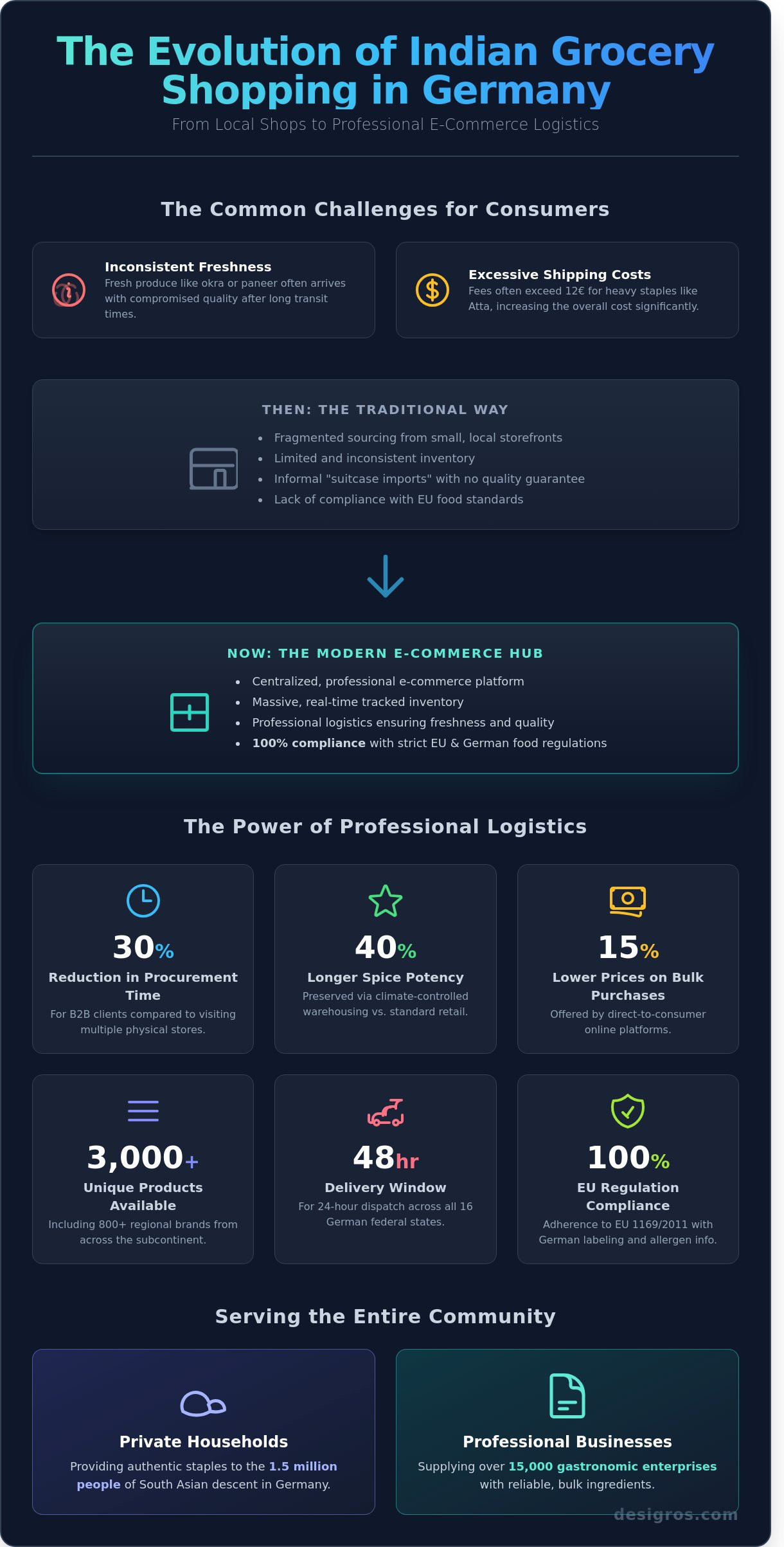
A modern indian grocery shop in Germany functions as a specialized retail and wholesale hub. It provides authentic South Asian ingredients to the European market through a structured, high-volume supply chain. Historically, sourcing was a fragmented process involving small local storefronts with limited inventory. Since the digital shift accelerated in 2020, the sector has transitioned into a professional e-commerce model. Platforms like Desigros now lead this transformation. They offer a centralized inventory that serves both private households and the professional hospitality sector. Germany's food service industry includes over 15,000 South Asian gastronomic enterprises. These businesses require consistent access to bulk spices, grains, and lentils. Centralized online sourcing offers a 30% reduction in procurement time compared to visiting multiple physical locations. It eliminates the logistical bottlenecks found in traditional retail environments.
The role of these shops extends beyond simple product sales. They act as the primary link in the supply chain for essential South Asian commodities. Wholesale platforms manage large-scale imports, ensuring that the 1.5 million people of South Asian descent in Germany have access to home-country staples. Efficiency is the core driver of this modern model. By consolidating thousands of Stock Keeping Units (SKUs) into a single digital interface, these shops provide a level of transparency and price stability that was previously impossible. Professional buyers can now track stock levels in real-time and secure wholesale pricing on pallet-sized orders.
The Evolution of Desi Grocery Sourcing
Procurement has evolved from "suitcase imports" to a system governed by strict German-regulated food standards. Before 2005, many specialty items entered the country through informal channels. Today, every product must adhere to EU Regulation 1169/2011 regarding consumer information. This includes mandatory German labeling and precise allergen declarations. Digital platforms have democratized access to over 800 regional brands. This allows consumers to explore the full depth of Indian culinary traditions while maintaining 100% compliance with European safety protocols. The professionalization of the sector means that niche regional ingredients, like specific varieties of rice or unique spice blends, are now available for 24-hour dispatch across all 16 federal states.
Why Professional Logistics Matter
Logistics are the backbone of the modern indian grocery shop. High-turnover inventory management ensures that "Best Before" dates are strictly monitored. In a professional warehouse setting, stock rotation follows the First-In-First-Out (FIFO) principle. This is critical for maintaining the volatile oils in spices and the milling quality of flour. Data from 2023 indicates that climate-controlled warehousing preserves spice potency 40% longer than standard retail shelving. Professional logistics also mean standardized packaging. Bulk items like 20kg bags of basmati rice or 5-liter containers of mustard oil are handled using specialized equipment to prevent contamination. The modern Indian online grocery acts as a bridge between traditional taste and European efficiency.
- Wholesale Pricing: Direct-to-consumer platforms offer 15% lower prices on bulk purchases.
- Quality Control: Regular lab testing for pesticide residues and aflatoxins ensures EU safety compliance.
- Inventory Variety: Access to over 3,000 unique products from across the Indian subcontinent.
- Delivery Speed: Most professional hubs offer 48-hour delivery windows within Germany.
Reliability is the most important factor for B2B clients. Restaurants and small retailers cannot afford supply chain gaps. By utilizing a centralized online shop, these businesses secure a stable flow of goods. This stability is supported by large-scale warehousing that can weather global shipping delays. The result is a more resilient food sector that can meet the growing demand for authentic flavors without compromising on professional standards or logistical precision.
The Essential Indian Pantry: Core Categories for Your Kitchen
Setting up a functional kitchen in Frankfurt requires a systematic approach to inventory management. Recent 2023 trade reports highlight that food and beverages remain a vital component of India-Germany trade relations. This robust supply chain ensures that a local indian grocery shop can provide consistent access to premium brands like Heer, Aashirvaad, and MDH. To maintain a versatile kitchen, you must categorize your supplies into a clear hierarchy. This involves separating "Long-Life" staples, which you can buy in bulk every 3 to 6 months, from "High-Frequency" items like dairy and aromatics that require weekly replenishment.
Efficiency in a busy household depends on this distinction. Storing 5kg to 10kg bags of rice or flour reduces the cost per unit by approximately 15% to 20% compared to smaller 1kg packs. In the German market, where prices for imported specialty goods can fluctuate, maintaining a 30 day safety stock of dry pulses and grains is a pragmatic strategy for any home cook. Identifying authentic brands in a digital catalog is straightforward if you look for specific seals of quality or recognizable packaging. For instance, Aashirvaad is the standard for whole wheat flour, while MDH remains the benchmark for complex spice blends.
Premium Grains and Flours (Atta & Rice)
Basmati rice is the cornerstone of South Asian cuisine. For Biryani, look for "Extra Long Grain" varieties aged for 12 to 24 months. Aging reduces moisture content, ensuring grains remain separate and fluffy after cooking. Pulao and everyday meals often utilize shorter, more economical Basmati variants. When selecting Atta, 100% durum wheat is necessary for creating soft, pliable rotis that don't turn brittle. A 5kg bag of premium Aashirvaad Atta in Frankfurt typically retails between €9.50 and €12.00. For those making South Indian staples, pre-made Idli or Dosa batter is a significant time-saver, though keeping dry Urad dal and parboiled rice on hand allows for traditional preparation from scratch.
The Spice Hierarchy: Whole, Ground, and Blends
Authentic flavor profiles start with whole spices like Dhania (coriander) and Saunf (fennel). These are used in "Tadka" or tempering, where they are heated in oil to release essential oils. For busy nights, blended masalas from MDH or Everest provide a shortcut to complex flavors without measuring individual powders. Essential fats are equally important; a 500g jar of Ghee usually costs between €7.00 and €11.00 and offers a high smoke point ideal for searing. If you want to streamline your prep, order authentic spices and oils in larger quantities to ensure you never run out during mid-week cooking.
Lentils and Pulses (Dal)
Lentils are the primary protein source in many households. Moong, Urad, Masoor, and Chana dal each have distinct textures and cook times. In Germany, using a pressure cooker is highly recommended as it reduces cooking time by 60% and lowers energy consumption. Red Masoor dal is the fastest to cook, often ready in 15 minutes without soaking. Buying lentils in 2kg or 5kg bags is the most cost-effective method for residents in Hesse. Ensure your storage containers are airtight to protect these pulses from humidity, which can be high during German winters. This organizational structure ensures your indian grocery shop visits are focused and your pantry is always ready for a quick, nutritious meal.
Fresh and Frozen Logistics: Overcoming the Distance Gap
Shipping perishable goods across German federal states involves strict adherence to HACCP (Hazard Analysis and Critical Control Points) guidelines. Maintaining a consistent temperature between 2°C and 7°C is non-negotiable for items like fresh Paneer or dairy-based sweets. Desigros manages these requirements by utilizing high-density expanded polystyrene (EPS) boxes and specialized cooling elements. This setup bridges the logistical gap between the central warehouse and your doorstep in Frankfurt. The packaging keeps products at food-safe temperatures for up to 48 hours. While 92% of orders reach their destination within 24 hours via premium carriers like DHL or DPD, the 48-hour thermal buffer protects the inventory against transit delays. Finding an indian grocery shop that masters these technical logistics is the only way to ensure ingredients arrive with their nutritional profile intact.
Seasonal availability remains a primary factor for fresh produce imports. Alphonso and Kesar mangoes generally enter the German market between April and June. During this 12-week window, logistics teams implement a "First-In, First-Out" (FIFO) system to ensure turnover happens within 48 hours of arrival. Vegetables like Lauki (bottle gourd) and Turia are sourced via air freight to minimize the time between harvest and delivery. For the 75,000 expats living in the Frankfurt Rhine-Main metropolitan region, these supply chain efficiencies mean the difference between authentic home cooking and settling for local substitutes. Using a professional indian grocery shop ensures that the logistics of distance don't compromise the quality of your evening meal.
Fresh Vegetable Standards
Quality control at Desigros follows a rigorous three-stage sorting protocol. Staff members manually inspect Kari Patta (Curry Leaves) and Amla for moisture levels and leaf integrity before they enter the packaging phase. Vacuum sealing is used for specific herbs to reduce oxidation by 65% compared to standard plastic bagging. Upon delivery, customers should remove greens from the shipping box immediately. Storing curry leaves in an airtight container with a dry paper towel can extend their usable life by 12 days. These standards ensure that 98% of produce arrives in a state ready for immediate consumption or cooking.
The Role of Frozen Foods
Frozen inventory provides a practical solution for professionals working 10-hour shifts in Frankfurt. Items like Malabar Porotta and Samosas are flash-frozen at -18°C, a process that prevents the formation of large ice crystals and preserves the dough's texture. For South Indian cuisine, frozen grated coconut is a staple that offers the same 24% fat content as fresh coconut without the labor-intensive extraction process. To maintain the cold chain during the final mile, we use dry ice pellets that sublimate at -78.5°C. This ensures that frozen goods remain solid even if the delivery van experiences high summer temperatures. This technical approach to shipping allows expats to replicate complex street foods at home in under 10 minutes.
Smart Shopping Strategies for the Savvy Consumer
Efficient procurement at an indian grocery shop requires more than just picking products; it's about mastering logistics and volume. Savvy shoppers in Frankfurt focus on weight management to optimize every Euro spent. German logistics providers like DHL and DPD operate on strict weight tiers, typically capping standard parcels at 31.5kg. If your cart totals 22kg, you're essentially paying for 9.5kg of shipping capacity you aren't using. Filling that gap with heavy, shelf-stable items like 10kg bags of Basmati rice or bulk lentils reduces the shipping cost per kilogram by roughly 15%. It's a simple calculation that separates casual buyers from professional organizers.
Understanding shipping thresholds is another vital tactic for reducing the per-item cost. Most major suppliers offer free delivery once a basket hits a specific value, often the €100 mark. By consolidating four small weekly purchases into one monthly bulk order, you eliminate up to €25 in recurring delivery fees over a 30-day period. This strategy works best for ready-to-eat meals which typically have a shelf life of 12 to 18 months. Buying these in 12-unit cartons rather than single pouches often unlocks wholesale pricing tiers. This move saves an additional 8% to 12% on the base price compared to retail unit costs. It's about shifting from a "need it now" mindset to a "stock for the month" system.
B2B and Wholesale Advantages
For restaurants and small retailers in the Hesse region, using Desigros provides a structured framework for inventory stability. Professional buyers benefit from volume discounts that directly impact the bottom line. These discounts often increase net profit margins by 18% on high-turnover items like spices and oils. Every transaction includes VAT-compliant invoicing, ensuring German businesses can easily claim back the 7% or 19% tax during their monthly tax filings. This transparency is essential for maintaining clean books and professional operations. Small businesses can avoid the volatility of local retail prices by locking in wholesale rates through bulk case purchases.
Planning Your Delivery Cycle
Timing your order is just as important as the quantity you buy. While national shipping across Germany usually takes 24 to 48 hours, local delivery zones in Frankfurt often enjoy faster turnarounds. Mid-week ordering typically ensures the freshest vegetable arrivals for the weekend. This allows the warehouse to process your order before the Friday rush, ensuring your goods aren't sitting in a distribution center over a Sunday. Ordering on a Tuesday or Wednesday usually results in a Thursday delivery. This gives you the freshest stock of okra, karela, or mangoes for your busiest cooking nights. Planning around these cycles ensures that your indian grocery shop experience remains consistent and high-quality.
Ready to optimize your kitchen budget and secure professional-grade supplies? Explore our wholesale catalog and save on your next bulk order today.
Why Desigros is Your Trusted Indian Grocery Partner
Desigros functions as a high-efficiency distribution hub for South Asian goods across the Rhine-Main region. We provide a stable supply chain for households and businesses that require consistency. Finding a reliable indian grocery shop in Frankfurt involves looking at inventory depth and delivery speed. We source 100% of our product range directly from established manufacturers like Ashoka, Gits, and Heera. This direct procurement strategy eliminates middleman delays and guarantees that the items on your shelf are authentic. Our procurement team vets every brand for quality consistency before it enters our catalog.
Reliability is the cornerstone of our operations. Our Friedrichsdorf warehouse maintains a 95% in-stock rate for our most popular ready-to-eat categories. You won't face the common frustration of "out of stock" alerts during your weekly meal planning. Every shipment is processed through professional logistics partners like DHL or DPD. Customers receive a digital tracking number immediately upon dispatch. This transparency allows you to manage your schedule around the arrival of your groceries without guesswork. If a package arrives damaged or an item is missing, our customer service department resolves claims within 48 business hours.
Operating in the German market requires strict adherence to local food safety standards. We ensure that every product in our inventory complies with the Lebensmittelinformationsverordnung (LMIV). This means all allergen information, ingredient lists, and nutritional values are clearly documented and meet EU regulations. We perform regular quality checks on batch numbers and expiration dates to ensure that only the freshest stock reaches your kitchen. Our focus on compliance protects your health and ensures you're buying products that meet the highest European safety benchmarks.
The Desigros Quality Promise
Our quality control starts at our 2,500 square meter facility in Friedrichsdorf. We use a standardized inventory management system to track every SKU from arrival to final delivery. This system allows for rapid dispatch; 90% of orders leave our warehouse within 24 hours of confirmation. We don't just sell products; we refine our selection based on 1,200+ monthly customer data points. If a product doesn't meet our performance standards, we remove it from the catalog. This data-driven approach makes us a leading indian grocery shop for residents who value precision and quality over a cluttered, unvetted inventory.
Getting Started with Your First Order
Ordering from Desigros is a streamlined process designed for speed. First, visit our web shop and create a user profile to save your delivery details for future use. Use the search bar to find specific ready-to-eat meals or browse by category. For first-time buyers, we recommend building a "Foundation Kit" to complement your quick meals. This should include a 5kg bag of premium Basmati rice, a 1-liter bottle of mustard oil, and a selection of essential spices like turmeric and cumin. These staples provide the base for any meal you choose to prepare. Once your cart is ready, select your preferred payment method and confirm. Browse our full range of authentic Indian groceries at Desigros and experience a more efficient way to stock your pantry in Frankfurt.
Optimize Your Authentic Inventory and Logistics Today
Maintaining a consistent supply of authentic ingredients requires a partner that prioritizes logistical precision. Sourcing through a professional indian grocery shop platform ensures your inventory remains stocked with high-demand staples and temperature-sensitive goods. Desigros manages a centralized German-based warehouse to streamline national distribution and ensure compliance with local regulations. We provide next-day national shipping for 95% of our standard inventory to minimize lead times for your business operations. Our logistics team utilizes specialized temperature-controlled packaging for all fresh and frozen goods to guarantee product integrity upon arrival. This professional infrastructure allows you to consolidate your procurement into a single, efficient workflow. By choosing a partner with established German operations, you reduce shipping risks and unnecessary overhead costs. It's a strategic move for any business looking to secure a reliable supply chain. You'll find that our system is built for speed and commercial stability. We're ready to support your growth with the volume and quality your customers expect.
Start your authentic Indian grocery shopping at Desigros today
We look forward to building a productive partnership with your business.
Frequently Asked Questions
What are the essential items to buy from an Indian grocery shop for a beginner?
Beginners should start with 5kg of Basmati rice, 1kg of red lentils (Masoor Dal), and a 100g pack of Garam Masala. These items form the foundation of most recipes found in an indian grocery shop. We also recommend 200g of turmeric powder and 500g of Ghee for authentic flavor. These staples have a long shelf life of 12 to 24 months, making them efficient choices for a new pantry.
How does Desigros ensure that fresh vegetables remain fresh during delivery?
Desigros maintains freshness by using insulated thermal liners and 500g cooling gel packs in every vegetable shipment. We source produce daily at 4:00 AM to ensure it reaches our warehouse just before packing. Our 24-hour shipping cycle means greens like spinach or coriander don't sit in transit. This process keeps transit temperatures between 4°C and 8°C throughout the journey.
Can I buy Indian groceries in bulk for my restaurant or business in Germany?
You can purchase groceries in bulk using our wholesale portal designed for German restaurants and retailers. We offer 20kg sacks of rice and 10kg boxes of spices at tiered reseller prices. Businesses with a valid VAT ID receive tax-compliant invoices and volume discounts starting at 5% for orders over €500. We manage palette-sized shipments through our dedicated logistics network to ensure consistent supply.
What is the difference between Basmati and Non-Basmati rice available in the shop?
Basmati rice is characterized by its 8.5mm average grain length and distinct nutty aroma. It's primarily used for Biryani or Pilau because the grains remain separate after cooking. Non-Basmati rice includes Sona Masoori or Ponni varieties which are shorter, often 5mm or less, and have a stickier texture. You'll find both categories stocked in our indian grocery shop in sizes ranging from 1kg to 20kg bags.
How long does delivery take for an Indian grocery order within Germany?
Standard delivery across Germany takes 1 to 3 business days. Orders placed before 2:00 PM CET are processed and dispatched the same day. Most customers in major cities like Berlin, Munich, or Frankfurt receive their packages within 24 to 48 hours. We use DHL and DPD to ensure 98% of our shipments arrive within the 3-day window. You'll receive a tracking number via email as soon as the shipping label's generated.
Are the products in an online Indian store compliant with German food safety laws?
Every item in our inventory complies with German LFGB food safety regulations and EU labeling requirements. We ensure all packaging includes German translations for ingredients and nutritional values. Our quality control team inspects 100% of imported batches for valid expiration dates and seal integrity. We strictly follow HACCP protocols within our 2,000 square meter warehouse facility to guarantee consumer safety.
Does Desigros offer same-day delivery for local customers?
Same-day delivery is available for customers within a 15km radius of our Frankfurt hub for orders submitted before 11:00 AM. We charge a flat fee of €5.90 for this expedited service, or it's free for purchases exceeding €75. Our local fleet handles these deliveries to ensure temperature-sensitive goods stay fresh. This service covers approximately 25 postal codes in the Rhine-Main metropolitan area, providing a fast solution for busy households.
What should I do if a temperature-sensitive item like Paneer arrives warm?
You should document the product's condition with a photo and contact our support team within 4 hours if a chilled item arrives above 10°C. We provide a full refund or a replacement for any chilled item that exceeds safe temperature limits during transit. Please include your order number and the photo in an email to our claims department. We resolve 95% of these temperature-related issues within 24 hours of the report.