

Last Saturday, a professional caterer in Berlin saw their traditional Upma turn into a sticky porridge because they used Weichweizengrieß instead of the coarse variety required for the dish. It's a common frustration for anyone trying to replicate authentic textures using standard German retail supplies. Understanding the technical specifications of semolina semolina is essential for consistent results, whether you're preparing Italian pasta or South Indian Rava Dosa. You shouldn't have to guess which grain size works for your commercial or home kitchen needs.
This guide clarifies the technical differences between Hartweizengrieß and Weichweizengrieß so you never ruin a recipe again. We'll provide a clear mapping of traditional dishes to their correct grain textures and explain the nutritional profiles of each type. You'll also discover how to source consistent, high-quality Sooji and Rava in bulk within the German market. By the end, you'll have the technical knowledge to select the right product for every application, ensuring your inventory meets the highest culinary standards.
Key Takeaways
- Understand the technical differences between durum and soft wheat to navigate the diverse "semolina semolina" spectrum for both Indian and European recipes.
- Identify why Hartweizengrieß is the essential German market equivalent for achieving the authentic texture required for traditional Sooji and Rava dishes.
- Master professional preparation techniques, including dry-roasting methods and precise water ratios, to ensure consistent culinary results and optimal flavor.
- Learn how to source high-quality wholesale brands like TRS and Heera in Germany to ensure reliable supply and authentic grain textures for commercial use.
What is Semolina? Understanding the "Semolina Semolina" Spectrum
Semolina is the coarse, purified middling of durum wheat, a hard wheat species known scientifically as Triticum durum. Unlike common bread wheat, durum wheat possesses a high protein content, typically ranging from 13% to 15%. This protein density provides the structural integrity required for pasta and specific breads. When professional buyers or home cooks search for semolina semolina, they're usually navigating the spectrum between coarse and fine textures. This distinction determines the final product's "bite" and moisture absorption rate. In the German wholesale market, providing the correct granulation is a logistical priority for maintaining consistent production cycles in industrial kitchens.
The history of this grain dates back to approximately 7,000 BC in the Mediterranean basin. It remains a primary caloric staple in 22 North African and Middle Eastern countries. The production process involves a specialized milling technique. Instead of crushing the grain into a fine powder, corrugated steel rollers crack the wheat. This allows for the efficient separation of the nutrient-dense endosperm from the fibrous bran and germ. In 2023, the global demand for high-quality Semolina continues to rise, driven by its versatility in both sweet and savory applications. Professional procurement focuses on the "semolina semolina" variety to ensure they have the right grit for everything from traditional German Grießknödel to Italian extrusion-press pasta.
The Anatomy of a Wheat Grain
The endosperm makes up about 83% of the wheat kernel's weight and is the sole source of semolina. Durum wheat is the gold standard here because its starch is trapped in a protein matrix that doesn't break down easily during cooking. Refined semolina removes the bran and germ to maximize shelf stability and achieve a bright yellow hue. In contrast, whole-wheat versions retain the bran, increasing fiber content but shortening the shelf life to roughly 6 months at room temperature. For high-volume catering, refined versions are preferred for their 12-month storage reliability in dry warehouse conditions.
Global Names: Sooji, Rava, and Semola
Language differences often confuse international trade. In North India, you'll find this product labeled as "Sooji," while South Indian recipes call for "Rava." These terms often refer to the same durum middlings used for upma or halwa. In Italy, "Semola" refers to the flour, while "Semolina" generally describes the coarser grains. German wholesalers use the term "Grieß" to categorize these products. Whether you're ordering a 25kg sack of Hartweizengrieß (durum) or Weichweizengrieß (soft wheat), understanding these regional synonyms is vital for accurate inventory management. Most German retailers stock Grieß in 500g or 1kg units, but B2B platforms focus on bulk volumes for cost efficiency.
- Durum Semolina: Best for pasta and couscous; holds shape under high heat.
- Soft Wheat Semolina: Preferred for puddings, desserts, and baby food.
- Coarse vs. Fine: Coarse grains average 500 micrometers; fine grains are closer to 150 micrometers.
Selecting the right grade impacts the hydration levels of your dough. Coarse grains take longer to absorb water but provide a superior al dente texture. Fine grains mix quickly, making them ideal for silky gnocchi or dusting baking peels. In the German food sector, the 2024 price index for premium durum remains sensitive to harvest yields in Canada and Italy, the two largest exporters. Businesses must track these fluctuations to maintain their profit margins when sourcing bulk ingredients.
Types of Semolina: From Fine Flour to Coarse Grains
Semolina isn't a single, uniform ingredient. It represents a specific milling stage of wheat, specifically the purified middlings of hard wheat. In the professional food sector, distinguishing between varieties is essential for cost efficiency and product quality. Choosing the right semolina semolina grade determines the final yield, texture, and shelf stability of commercial food products. The primary distinction lies in the wheat source: Durum semolina is golden yellow and high in gluten, while soft wheat semolina is pale white and lower in protein.
The nutritional profile of semolina makes it a preferred choice for high-volume catering. A standard 100g portion of durum semolina contains approximately 12.7g of protein and 3.9g of dietary fiber. It's rich in B-vitamins, particularly folate and thiamine, which are vital for metabolic health. For retailers and wholesalers, understanding these metrics helps in marketing the product to health-conscious consumer segments. From a logistics perspective, semolina semolina is typically distributed in 1kg retail packs or 25kg industrial sacks to meet different market demands.
Coarse Semolina (Mota Sooji / Rava)
Coarse semolina, often labeled as "Mota Sooji" or "Rava" in international trade, features larger grain particles. These grains are resilient and don't break down easily during boiling. This characteristic prevents clumping in savory dishes like Upma or Khichdi, where grain separation is a quality benchmark. In the German market, professional buyers identify this as Grob Hartweizengrieß. It's the standard for traditional German Grießklößchen (semolina dumplings) because the coarse texture provides the necessary structural integrity to survive simmering in hot broth without disintegrating.
Fine and Extra Fine Semolina
Fine semolina is the industry standard for sweets like Halwa, Kesari, and various cakes. Its smaller particle size allows for rapid hydration and a smoother mouthfeel. In commercial pizza production, fine semolina is used to dust dough skins. This technique creates a non-stick barrier on the pizza peel and increases crust crunchiness by an estimated 15% compared to standard flour. Chiroti Rava, the extra-fine variant, is the secret behind delicate South Indian pastries. It's refined enough to create thin, crisp layers that don't feel gritty. For businesses looking to optimize their supply chain, sourcing consistent wholesale semolina varieties ensures production stability and uniform results across all batches.
The distinction between "Semolina Flour" and "Semolina Grains" is often a point of confusion in procurement. Semolina flour is the finely ground powder resulting from the second or third milling pass of the durum heart. It's the primary ingredient for premium pasta, providing the "al dente" bite that consumers expect. Semolina grains, or the coarser grits, are better suited for puddings and porridges where the goal is a thick, textured consistency. Industrial kitchens typically maintain stocks of both to cover the full spectrum of Mediterranean and Asian recipe requirements.
When evaluating stock for the German market, check for the "Type" classification on the packaging. While standard wheat flour uses numbers like Type 405 or 550, semolina is categorized by its grit size in microns. Coarse varieties usually fall between 600 and 1000 microns, while fine varieties stay below the 500-micron threshold. Maintaining this technical precision in your inventory management prevents costly errors in recipe execution and ensures customer satisfaction in B2B transactions.
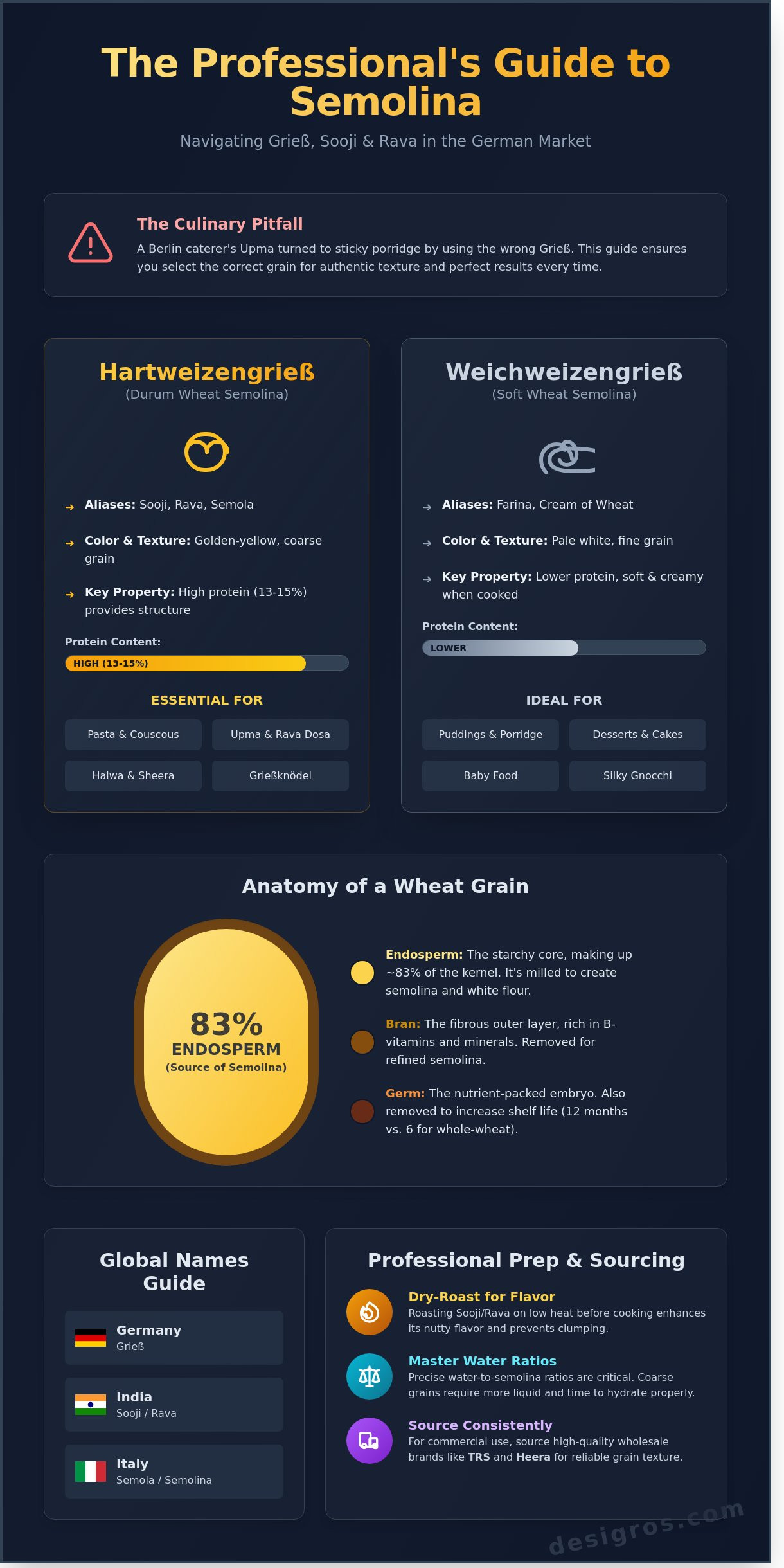
The German Market Guide: Grieß vs. Sooji
Shopping for semolina in German supermarkets like Rewe, Edeka, or Lidl requires a clear understanding of local labeling. You'll primarily encounter two products: Hartweizengrieß and Weichweizengrieß. These aren't interchangeable in professional or home kitchens. For wholesale buyers and retailers, stocking the correct semolina semolina grade is vital because the wrong choice ruins specific traditional textures. As of early 2024, a standard 500g package of store-brand semolina in Frankfurt retails for approximately €0.95 to €1.20, while organic Bioland versions often reach €1.80.
Hartweizengrieß is the direct equivalent of Indian Sooji. It's milled from durum wheat, which possesses the structural integrity needed for savory dishes. Many expatriates in cities like Friedrichsdorf mistakenly purchase "Kindergrieß" for savory recipes. This is a strategic error. Kindergrieß is almost always Weichweizengrieß (soft wheat semolina), designed to dissolve into a smooth, mushy consistency for infants. If you attempt to make Upma with soft wheat, the dish turns into a sticky, unappealing paste rather than maintaining its distinct, grainy fluffiness.
Availability in the Rhine-Main region is high. In Frankfurt's Kleinmarkthalle or specialty shops in Friedrichsdorf, you'll find diverse options ranging from coarse to fine grinds. For large-scale catering or retail, focusing on Hartweizengrieß ensures the product meets the demands of both Mediterranean and South Asian cuisines. Understanding the technical specifications of these grains prevents inventory waste and culinary failure.
Hartweizengrieß: The Pasta and Pilaf Choice
Hartweizengrieß contains a high protein content, typically ranging from 12.5% to 14.7% depending on the harvest year. This high gluten level provides the necessary "bite" or al dente quality. It's the primary ingredient for homemade pasta and couscous. Professional chefs often look for culinary uses for semolina that require thermal stability. German Bioland and EU Organic certifications match the texture of premium Indian "Chiroti" or coarse Sooji brands like Rajdhani or Shakti Bhog. These organic versions provide a cleaner taste profile and consistent granulation for commercial food production.
Weichweizengrieß: For Desserts and Puddings
Weichweizengrieß is the standard base for the traditional German "Grießbrei," a sweet semolina pudding often served with cherries or cinnamon. It's milled from common bread wheat, which has a lower gluten strength. This type absorbs liquids rapidly and loses its individual grain definition. While it fails in savory pilafs, it's an excellent substitute for Indian "Sheera" or "Halwa" if a very smooth, melt-in-the-mouth texture is desired. In a professional B2B context, semolina semolina varieties from soft wheat are categorized as dessert-grade grains. They're priced similarly to durum versions but serve a completely different segment of the market. Using soft semolina for savory snacks like Rava Vada will result in a lack of crispness; therefore, always verify the "Hart" or "Weich" prefix on the bulk packaging before confirming an order.
- Hartweizengrieß: Best for Upma, Rava Idli, Pasta, and Pizza dough.
- Weichweizengrieß: Best for Grießbrei, Halwa, and baby food.
- Protein Check: Look for 12% or higher for savory durability.
- Local Tip: "Grießfix" products often contain added thickeners; avoid these for authentic Indian recipes.
Practical Culinary Applications and Prep
Success with semolina semolina depends on heat management and hydration levels. Professional kitchens prioritize consistency, which starts with the preparation of the raw grain. Whether you're aiming for a fluffy breakfast dish or a dense dessert, the physical state of the semolina before it hits the water is what defines the end result. In a commercial setting, mastering these basics reduces waste and ensures a repeatable product for customers.
The Art of Roasting Sooji
Roasting is the foundational step that distinguishes professional-grade preparation from amateur cooking. It alters the starch structure, ensuring the grains remain distinct rather than clumping into a paste. For dry roasting, place the semolina in a heavy-bottomed pan over medium heat. Stir continuously for 6 to 9 minutes. The goal is a uniform, pale golden hue. Ghee roasting follows a similar timeline but uses approximately 15g of clarified butter for every 100g of grain. This method creates a deeper, more complex flavor profile suitable for premium desserts.
The "aroma test" serves as the primary quality control metric. You'll notice a transition from a neutral, floury scent to a robust, nutty fragrance similar to toasted nuts or popcorn. If the color turns dark brown, the batch is overdone and will taste bitter. Pre-roasting your semolina stock provides a significant advantage by destroying any existing insect eggs and removing residual moisture, which extends the product's shelf-life by up to 180 days.
Top 3 Recipes for Your Semolina Stock
Efficient menu planning relies on versatile ingredients. These three applications demonstrate how a single semolina stock can cover various meal categories:
- Savory: 15-minute Vegetable Upma. This breakfast staple uses a 1:2.5 semolina-to-water ratio. Sauté mustard seeds, curry leaves, and diced carrots before adding the roasted grain and boiling water. It's a high-margin, quick-service option for catering businesses.
- Sweet: Classic Suji Ka Halwa. Use a 1:1:3 ratio of semolina, sugar, and water or milk. The Prasad-style halwa requires heavy ghee roasting to achieve its signature velvety texture. It stays stable for hours in a warming tray without losing its appeal.
- Fusion: Semolina-crusted fish or paneer. Replace traditional German Paniermehl with fine semolina. It provides a superior crunch that doesn't get soggy as quickly as standard breadcrumbs. This is particularly effective for high-volume frying operations.
In the German climate, storage requires specific attention to humidity and pests. Pantry moths, known locally as Dörrobstmotten, are a frequent issue in European storage facilities. Keep your stock in airtight containers at temperatures below 19°C. If you're managing larger volumes, ensure the storage area is well-ventilated to prevent the grain from absorbing ambient moisture. Maintaining a consistent supply of semolina semolina is vital for businesses focusing on high-volume production where ingredient quality cannot be compromised.
Semolina also functions as an excellent thickening agent for soups and stews. Unlike cornstarch, which can create a translucent, gel-like appearance, semolina adds body and a rustic texture. Use 25g of fine semolina per 500ml of liquid to thicken a vegetable broth. It's a cost-effective alternative to expensive thickeners and integrates well into traditional German recipes like Grießklößchensuppe. When preparing semolina semolina for large batches, precision in the roasting phase determines the final mouthfeel of these soups.
Where to Buy Authentic Semolina in Germany: The Desigros Advantage
Sourcing high quality semolina semolina in Germany requires looking beyond the standard supermarket shelves. While local discounters stock basic wheat semolina, these products often lack the specific granulation levels required for authentic Indian, Middle Eastern, or Mediterranean cooking. Desigros functions as a specialized bridge, providing access to professional grade Sooji that meets strict culinary standards. We source our inventory from reputable brands like TRS and Heera to ensure that every bag contains the correct protein content and grit size for dishes ranging from Upma to fresh pasta.
Our Friedrichsdorf distribution hub serves as the central point for our logistics network. We maintain a high turnover rate, which means our stock never sits in the warehouse for long periods. This fast rotation guarantees that the semolina you receive is fresh and free from the staleness often found in smaller, low volume retail shops. We support both individual households and the professional catering sector with a range of packaging options that prioritize value and product integrity.
- Retail Sizes: 1kg and 2kg packs for regular home cooking.
- Wholesale Quantities: 5kg, 10kg, and 20kg bulk bags for restaurants and large families.
- Business Solutions: Pallet shipping available for retailers and high volume food production units.
Online Shopping Made Easy
The Desigros online platform simplifies the procurement process for customers across Germany. We utilize a streamlined inventory management system to ensure that the 1kg or 5kg packs you see online are physically present in our Friedrichsdorf warehouse. Most customers choose to bundle their semolina semolina order with other essential dry goods. You can add mustard seeds, curry leaves, and premium ghee to your cart in a single transaction. This "everything from one source" approach reduces shipping costs and saves time. For those located in the Frankfurt am Main region, we offer next day delivery options to keep your kitchen running without interruption.
Quality Assurance and Brands
Brand selection is a critical factor in achieving the right texture for your recipes. TRS Semolina remains a top choice for German Indian households because of its consistent milling process. When you compare a premium Indian Sooji to standard supermarket Grieß, the difference in granulation is immediate. Standard supermarket options often cost around 0.80€ per 500g but lack the distinct coarse or fine separation needed for specialized textures. Our premium brands, priced competitively at roughly 1.80€ to 2.50€ per kilogram, offer better absorption rates and a superior mouthfeel. We verify every batch for purity and moisture content before it enters our shipping cycle.
Choosing Desigros means you are partnering with a supplier that understands the technical requirements of professional kitchens. We eliminate the guesswork involved in finding the right "Sooji" by providing detailed product descriptions and reliable brand names. Whether you are a home cook perfecting a family recipe or a restaurant owner managing a busy service, our logistics infrastructure ensures you never run out of this essential staple.
Ready to restock your pantry with professional grade ingredients?
Optimize Your Kitchen with Professional Grade Semolina
Mastering the diverse semolina semolina spectrum is the first step toward authentic South Asian and European cooking in Germany. Identifying the precise differences between fine Grieß and coarse Rava ensures your textures remain consistent, whether you're preparing traditional Halwa or savory Upma. Professional kitchens rely on specific grain sizes to maintain quality standards; sourcing these shouldn't be a logistical hurdle. Desigros simplifies your procurement by stocking authentic brands like TRS and Heera, ready for immediate shipping from our central warehouse. We utilize temperature-controlled logistics to ensure every 1kg or 20kg bag arrives in peak condition. Our delivery system spans the entire country, providing fast turnaround times that keep your operations running without interruption. You'll find our stock is updated weekly, reflecting our commitment to freshness and competitive pricing in the German market. It's time to upgrade your ingredient sourcing with a partner that understands wholesale efficiency and culinary authenticity.
Order Authentic Indian Sooji and Rava for your kitchen today
Reliable supply chains and premium quality are just a few clicks away.
Frequently Asked Questions
Is semolina the same as cornmeal or polenta?
No, semolina and cornmeal are distinct products derived from different botanical sources. Semolina comes from durum wheat and contains approximately 13% protein, whereas cornmeal and polenta are produced from ground maize. While they share a similar coarse texture, their flavor profiles and gluten content differ significantly. You can't swap them in recipes like pasta or traditional Italian bread without changing the structural integrity and 100% of the final taste.
Can I use semolina if I am on a gluten-free diet?
You can't eat semolina on a gluten-free diet because it's a direct byproduct of durum wheat. This grain has a high gluten density, which provides the elasticity needed for pasta and bread. For those with celiac disease or gluten sensitivity, 0% of traditional semolina products are safe for consumption. Instead, look for certified gluten-free alternatives made from rice or maize that mimic the 200 to 300 micron particle size of fine semolina.
What is the difference between Sooji and Rava?
There is no functional difference between Sooji and Rava because both terms refer to granulated durum wheat. In North India, people typically use the word Sooji, while Rava is the common term in South India. Both products are available in our wholesale inventory in 1kg or 5kg bags for commercial use. Whether you buy Sooji or Rava, you're getting the same semolina semolina product required for traditional Indian breakfast dishes or desserts.
How do I stop my semolina halwa from becoming lumpy?
Prevent lumps in semolina halwa by adding the boiling liquid slowly while whisking the grains continuously. It's vital to toast the grains in ghee for 8 to 10 minutes until they turn golden brown before introducing any moisture. This process coats the individual starch granules, ensuring they separate rather than clumping together. Maintaining a steady medium heat of 160°C during the toasting phase provides the best results for a smooth, professional texture.
Which semolina is best for making homemade pasta?
Fine-ground semolina, often labeled as "semola rimacinata," is the best choice for homemade pasta. Its smaller particle size allows for a smoother dough that hydrates quickly and rolls out without tearing. Coarse varieties are better suited for dusting work surfaces to prevent sticking. Professional kitchens in Germany often order 25kg bulk sacks of fine durum to ensure consistent dough quality across high-volume production cycles and maintain a lower cost per unit.
How long does semolina stay fresh in a typical German pantry?
Semolina stays fresh for 6 to 12 months when stored in a cool, dry German pantry at temperatures below 20°C. To maximize shelf life, move the product from its original paper packaging into an airtight glass or plastic container. This prevents moisture absorption and protects against common pantry pests. If you buy in bulk for your business, ensure your storage area maintains a humidity level below 60% to prevent spoilage and financial loss.
Can I use "Grieß" from Edeka for Indian Upma?
You can use "Hartweizengrieß" from Edeka or other German retailers for Indian Upma. Ensure you select the "Hartweizen" variety rather than "Weichweizengrieß," as the latter is intended for soft puddings and won't hold its shape in savory dishes. The 500g retail packs found in German supermarkets are identical in quality to standard Indian semolina semolina. For larger catering needs, purchasing 10kg units from a professional wholesaler is more cost-effective for your business operations.
Is semolina healthier than white rice?
Semolina is generally considered more nutrient-dense than white rice because it contains higher levels of protein and fiber. A 100g serving of semolina provides roughly 13g of protein and 3.9g of fiber, compared to 2.7g of protein and 0.4g of fiber in the same amount of white rice. It also has a lower glycemic index of 44, whereas white rice scores around 72. This means semolina provides a slower release of energy for better metabolic stability.