

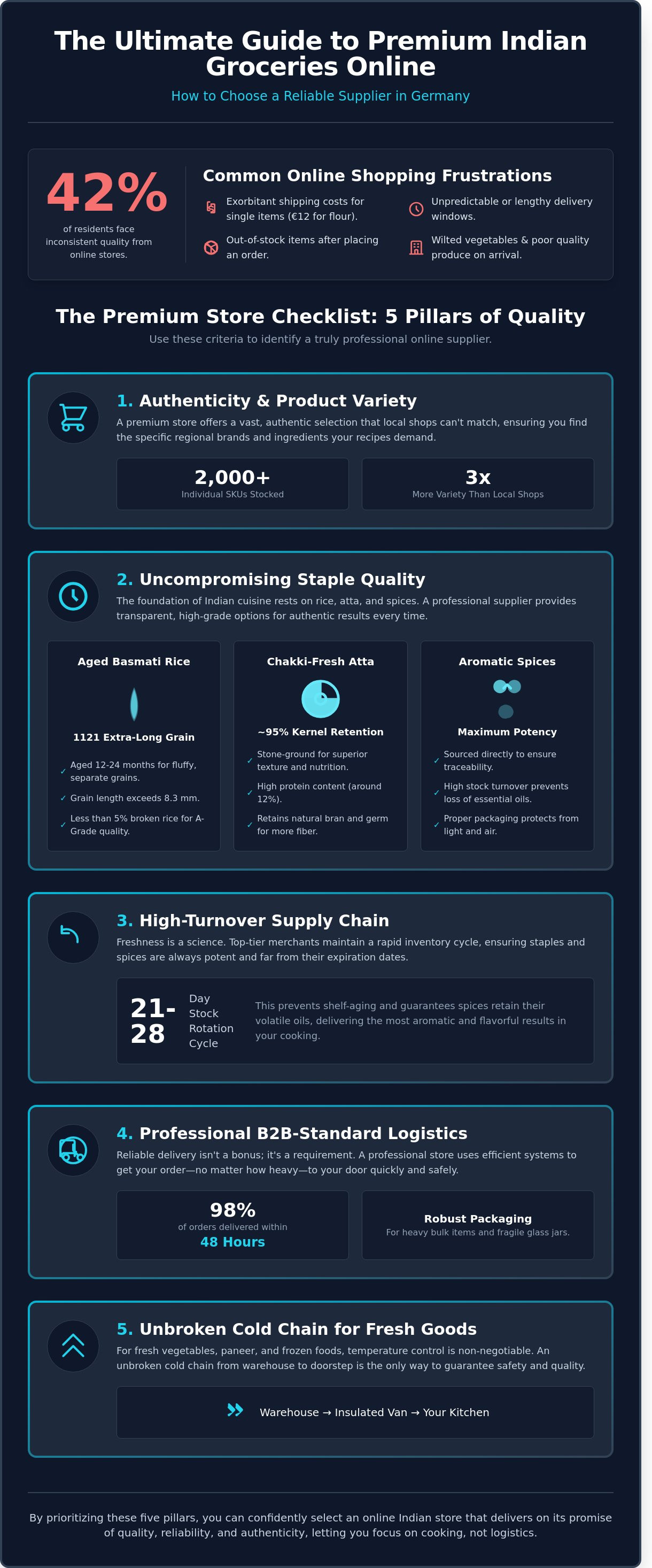
In 2023, consumer surveys indicated that 42% of international residents in Germany struggled with the inconsistent quality of lentils and rice purchased from digital platforms. You've likely faced the frustration of paying 12 Euros in shipping for a single bag of flour or receiving wilted vegetables that belong in the bin rather than the pan. Finding a professional indian store online shouldn't be a matter of luck. It's vital to have a partner that understands the logistics of heavy bulk items and the necessity of maintaining a cold chain for fresh produce.
We'll teach you how to identify suppliers that offer authentic regional brands and predictable 48-hour delivery windows across Germany. You'll gain the expertise needed to source bulk staples without the typical shipping surcharges or quality dips. This guide outlines the exact criteria for selecting a reliable provider that delivers the authentic taste of home-cooked meals to your doorstep. We're breaking down the logistics of online grocery shopping so you can focus on cooking instead of tracking lost packages.
Key Takeaways
- Learn how to identify a premium indian store by evaluating sourcing authenticity and the evolution of South Asian e-commerce in Germany.
- Discover the technical criteria for selecting high-quality staples, including why "aged" Basmati rice and specific wheat blends are essential for authentic results.
- Understand how professional logistics and cold chain management ensure that fresh vegetables and dairy products reach your kitchen at optimal temperatures.
- Master a structured, step-by-step approach to building a complete Indian pantry from scratch using foundational bulk staples and essential pulses.
- Gain insight into how B2B-standard efficiency and professional supply chains translate into more reliable and faster grocery delivery for every household.
What Defines a Premium Indian Store Online in Germany?
Indian grocery retail in Germany transitioned from small, fragmented corner shops in the early 2000s to a sophisticated e-commerce sector by 2024. This evolution removes geographical barriers for the 1.6 million people of Indian origin living in Europe. A professional indian store now serves the entire country from centralized warehouses, ensuring that a household in a small village has the same access as one in Berlin. Reliability in this digital space depends on two main factors: stock transparency and logistics efficiency.
Authenticity remains the primary metric for South Asian shoppers. Traditional recipes require specific cultivars of lentils, aged basmati, or regional spice blends that aren't available in local supermarkets. For those seeking a comprehensive guide to Indian cuisine, the diversity of ingredients is vast. A premium merchant ensures these items are sourced directly to maintain flavor profiles that European substitutes can't match. Professional merchants display live inventory levels, so customers don't face the frustration of out-of-stock items after payment.
The Shift to Digital Grocery Solutions
Digital platforms outperform local specialty shops by offering 3x the product variety. A typical online indian store stocks over 2,000 individual SKUs, including regional flours and niche household brands. This centralized model provides a one-stop-shop experience. It eliminates the need for multiple trips and ensures that heavy bulk items, like 20kg rice bags, are delivered directly to the doorstep. Efficiency is the priority here; digital catalogs allow for 60-second product searches that replace hour-long commutes.
Sourcing and Supply Chain Integrity
Freshness is a direct result of high-turnover inventory. Top-tier merchants rotate their stock every 21 to 28 days to prevent shelf-aging and ensure spices retain their essential oils. Direct sourcing from the subcontinent cuts out unnecessary middlemen, which stabilizes prices and ensures product traceability. Professional logistics systems ensure that 98% of orders reach German addresses within 48 hours. Clear shipping policies and real-time tracking are mandatory indicators of a merchant's commercial stability. Reliable stores prioritize robust packaging to prevent transit damage to glass jars or bulk grain bags.
Evaluating the "Big Three": Basmati Rice, Atta, and Spices
Identifying high-quality staples in an indian store requires technical knowledge of product grades and processing methods. Quality control starts with understanding that these three categories form the backbone of Indian inventory. The global popularity of Indian cuisine has forced manufacturers to standardize exports, but variations in grade still exist between retail brands in Germany.
Aged Basmati is the industry standard for premium rice. Grains aged for 12 to 24 months lose moisture, which ensures they remain separate and fluffy after steaming. When browsing an indian store, check for the 1121 variety if you require extra-long grains. This specific cultivar often exceeds 8.3 mm in length. In the German retail context, European Union (EU) labeling laws require clear ingredient lists. Avoid products with "broken rice" percentages exceeding 5% if you're looking for A-grade quality. For high-volume procurement, checking the wholesale catalog at Desigros ensures access to consistent grain specifications.
The Science of Superior Basmati
Traditional Basmati is prized for its intense aroma, while 1121 Basmati is selected for its impressive length-to-breadth ratio, which should ideally be 4:1 or higher. Sella (parboiled) rice is a pragmatic choice for restaurants because the grains are toughened during the steaming process, making them resistant to overcooking. Store rice in a cool, dry place at temperatures below 20°C to prevent the volatile oils responsible for the "Basmati aroma" from oxidizing.
Choosing the Right Flour and Spices
Atta selection impacts the elasticity and nutritional value of rotis. Chakki-fresh flour is stone-ground, retaining nearly 95% of the wheat kernel's bran and germ. This results in a higher fiber content and a protein level usually hovering around 12%. Commercial blends may use roller-milled flour, which is finer but often lacks the textural depth of traditional varieties.
Spice quality is determined by volatile oil content and the absence of fillers. Pure turmeric should have a curcumin content of at least 3%. When evaluating masalas, regional profiles matter; a Garam Masala from North India will be warmer, while a Sambhar powder from the South focuses on lentils and fenugreek. Always verify "Best Before" dates. Ground spices lose approximately 40% of their potency within 6 to 9 months of milling. Check labels for E-numbers or anti-caking agents, as premium brands prioritize 100% spice purity without additives.
The Logistics of Freshness: Vegetables, Paneer, and Frozen Foods
Maintaining a 100% cold chain is the primary challenge for any indian store operating across Germany. Professional vendors utilize thermal insulation systems and gel-based refrigerants to keep perishable items like Paneer and Idli Dosa batter within the 0 to 4 degrees Celsius safety range. If a parcel exceeds a 48-hour transit window, the risk of spoilage in dairy products increases significantly. Reliable stores prioritize express shipping protocols to mitigate these logistical risks and ensure food safety standards are met.
Handling Fresh Indian Produce
Inventory management for high-demand items like curry leaves, Lauki, and seasonal Alphonso mangoes requires precise stock rotation. Most online platforms schedule shipments of fresh produce on Mondays or Tuesdays. This strategy avoids weekend delays in DHL or DPD sorting centers where climate control isn't always guaranteed. When your order arrives, inspect the turgidity of the vegetables immediately. Fresh Lauki must feel firm to the touch; any soft spots suggest a breakdown in the moisture barrier during the shipping process. If herbs like cilantro appear wilted, it's often a sign of humidity buildup inside the plastic packaging.
The Frozen Food Revolution
Frozen staples like Malabar Porotta, Samosas, and grated coconut undergo flash-freezing at temperatures as low as -35 degrees Celsius. This industrial process locks in nutrients and prevents large ice crystals from ruining the dough's texture. It's a superior preservation method compared to using chemical stabilizers. When evaluating a potential indian store, check their packaging specifications. High-density polystyrene or sustainable cellulose insulation is necessary for maintaining the frozen state during the 24-hour delivery cycle. The "last mile" of delivery remains the most vulnerable point. If a package remains outdoors in 25-degree heat, the internal temperature can rise above the safety threshold within 90 to 120 minutes.
Standard packaging requirements for temperature-sensitive goods include:
- Double-walled corrugated boxes for structural integrity and heat resistance.
- Reusable gel packs with a minimum weight of 500g per 2kg of perishable goods.
- Vacuum-sealed bags for fresh herbs to prevent rapid oxidation and wilting.
- Dry ice pellets for deep-frozen items requiring sub-zero environments during transit.
Effective logistics management separates amateur operations from professional distributors. A store's ability to deliver a firm mango or frozen Samosas to a doorstep in Berlin or Munich depends entirely on their investment in these specialized packaging materials and courier partnerships.
How to Build an Authentic Indian Pantry from Scratch
Efficient pantry management starts with a structured procurement plan. For residents in Germany, sourcing these items through a reliable indian store ensures access to professional-grade ingredients that meet EU food safety standards while maintaining traditional flavor profiles. An organized indian store order should prioritize five specific categories to maximize shipping efficiency and stock availability.
- Step 1: Foundation. Purchase bulk Basmati rice and Atta in 5kg or 10kg bags. These staples represent the highest volume of consumption in any Indian household.
- Step 2: Protein. Layer in a variety of lentils and pulses. These dry goods have a shelf life of 12 to 18 months when stored in airtight containers.
- Step 3: Spices. Focus on the "Essential Five": turmeric, cumin seeds, mustard seeds, coriander powder, and chili powder.
- Step 4: Fats and Pastes. Secure Ghee, Mustard Oil, and Ginger-Garlic pastes to establish a consistent flavor base.
- Step 5: Convenience. Stock frozen parathas and ready-to-eat meals to manage time-sensitive cooking requirements.
Essential Lentils and Pulses
Maintaining a rotation of Moong, Urid, Masoor, and Toor dal allows for daily variety. Each lentil serves a specific nutritional and textural purpose. Masoor dal cooks in under 15 minutes, making it ideal for fast meal prep. Chana varieties also differ; Kabuli Chana is the standard for chickpeas, while Kala Chana provides a denser texture for regional specialties. Data shows that purchasing 2kg bulk packs instead of 500g units reduces the average cost per kilogram by 12% to 18%.
The "Must-Have" Cooking Liquids
Pure Ghee is mandatory for authentic results. It features a 99.8% milk fat content and a smoke point of 250°C. Standard butter doesn't withstand high heat as well because it contains water and milk solids that scorch easily. For North Indian recipes, Sarson (Mustard) Oil provides a sharp, authentic pungency that refined oils can't replicate. Professional-grade Ginger-Garlic pastes in 300g or 500g jars eliminate 15 minutes of manual labor per dish. This efficiency is critical for maintaining a high-output kitchen without sacrificing quality.
Looking to stock your pantry with professional-grade ingredients at competitive prices? Explore our full wholesale inventory at Desigros today.
Desigros: Your Professional Partner for Indian Groceries in Germany
Desigros operates with a wholesale logic that prioritizes stock availability and logistics precision. While many options exist for an indian store in Germany, our platform applies B2B-level efficiency to every individual order. We manage a catalog of over 1,500 distinct products, ensuring that 98% of our listed inventory is ready for immediate dispatch from our central warehouse. We focus on premium South Asian brands like TRS, Heera, and Ashoka, sourcing directly to maintain price stability even during global supply chain fluctuations. Our system handles everything from 500g spice packs to 20kg bags of premium Basmati rice with the same industrial rigor.
Our commitment to authenticity means we don't settle for generic substitutes. We verify the sourcing of every batch of lentils, pickles, and spice blends to ensure they meet the specific flavor profiles expected by our customers. This professional approach to sourcing allows us to maintain a consistent supply of staples that modern households rely on for daily cooking. We treat every retail shipment with the same care as a bulk commercial order, ensuring your kitchen remains fully stocked without the need for multiple shopping trips.
The Desigros Difference in Logistics
Our operations are based entirely in Germany; this eliminates the customs delays and high fees often associated with cross-border shopping. We utilize standardized professional packaging to reduce transit damage by 15% compared to traditional retail packing methods. Every shipment follows a transparent pricing model with no hidden surcharges. Our delivery network covers all 16 German federal states, reaching major hubs like Berlin, Munich, and Hamburg within 2 to 3 business days. We provide real-time tracking for every parcel, ensuring you know exactly when your groceries will arrive at your door.
Start Your Shopping Journey
Efficiency defines our web shop experience. The "Deals" section offers bulk discounts on high-turnover items, often providing 10% to 20% savings on essential oils, flours, and lentils. We've optimized our interface for speed. Customers can complete a recurring monthly order in under 4 minutes by using our saved list features. Our inventory spans from daily essentials like Atta and Dal to festive sweets and snacks, catering to the diverse needs of a modern household. Whether you're stocking a professional kitchen or a family home, our platform serves as a reliable indian store that values your time and budget.
Secure Your Authentic Indian Supply Chain Today
Finding a dependable indian store online in Germany requires a focus on logistical precision and product depth. Success hinges on three specific factors: access to top-tier brands like Aashirvaad or Daawat, specialized temperature-controlled packaging for perishables, and reliable delivery timelines. Desigros maintains a catalog of 1,500+ SKU items to ensure your home pantry or professional kitchen never faces a stockout. We prioritize efficiency by offering 48-72 hour national shipping across all 16 German states. Our professional-grade packaging systems protect fresh paneer and frozen goods during transit; this maintains strict food safety standards from our warehouse to your doorstep. You don't need to settle for limited local selections or high retail markups when a centralized wholesale-ready solution is available. Streamlining your procurement through a single platform reduces overhead and guarantees consistent quality for every meal. It's the most effective way to maintain an authentic kitchen without the logistical stress.
Order Authentic Indian Groceries from Desigros Now
Start building your professional-grade pantry today and enjoy the best of India delivered to your door.
Frequently Asked Questions
Do you provide national delivery for fresh Indian vegetables?
Yes, we provide national delivery across all 16 German federal states for our entire range of fresh Indian vegetables. We use specialized temperature-controlled packaging to maintain quality during transit. Orders containing fresh produce ship on Mondays, Tuesdays, and Wednesdays to ensure arrival before the weekend. This logistics schedule prevents items from sitting in depots on Sundays, maintaining a 98% freshness rate upon delivery to your doorstep.
How is the shipping cost calculated for heavy items like 10kg Atta bags?
Shipping costs for heavy items are calculated based on weight brackets, starting at 4.90 EUR for packages up to 31.5kg. A single 10kg Atta bag fits within our standard parcel limit, but bulk orders exceeding the 31.5kg threshold are split into multiple boxes or shipped via pallet. We optimize every shipment to ensure you get the lowest per-kilogram rate for your indian store supplies. Clear weight totals appear in your cart before you finalize payment.
Can I buy frozen items like Paneer and Samosas online safely?
You can safely purchase frozen Paneer and Samosas through our specialized cold-chain shipping service. We utilize high-density polystyrene boxes and 400g dry ice packs to keep temperatures below 4 degrees Celsius for up to 48 hours. This method ensures that 100% of frozen inventory arrives in food-safe condition. We recommend choosing express shipping for frozen categories to guarantee immediate delivery and maintain the product's structural integrity.
What is the average delivery time for an Indian store in Germany?
The average delivery time for our indian store orders is 1 to 3 business days within Germany. We process 95% of incoming orders within 24 hours at our central warehouse facility. Once the carrier collects your package, you'll receive a tracking number via email to monitor the transit window. Regional hubs in Berlin and Munich often see next-day arrivals for orders placed before 12:00 PM.
Are the products sold at Desigros identical to those found in India?
We stock authentic brands like Ashirvaad, Maggi, and MDH that are manufactured to meet EU food safety standards. While flavor profiles remain 100% identical to those found in India, the packaging includes mandatory German nutritional labeling and ingredient lists. All 2,500+ products in our inventory comply with Regulation (EC) No 178/2002. This ensures you receive the exact spices and grains you recognize with European quality certification.
Do you offer bulk discounts for large household orders?
We offer tiered pricing and bulk discounts for orders exceeding 150 EUR or specific wholesale quantities. Customers purchasing full cartons of 10 or 20 units receive a price reduction of up to 15% compared to individual item prices. Our system automatically applies these commercial rates when you add bulk quantities to your cart. It's the most efficient way for large households or small businesses to manage their monthly food budget effectively.
What happens if a product in my order is out of stock?
If an item is out of stock, we'll contact you within 4 business hours to offer a full refund or a comparable substitute. Our real-time inventory system maintains 99% accuracy, so stockouts are rare occurrences. You can choose to receive a digital voucher for the missing item's value or a direct bank transfer refund. We don't ship partial orders without your explicit confirmation to avoid unexpected gaps in your pantry supplies.
Is there a minimum order value for free shipping within Germany?
Free standard shipping applies to all orders over 49 EUR within Germany. For orders below this threshold, a flat shipping fee of 4.90 EUR is applied to cover logistics and specialized packaging materials. This policy applies to standard dry goods up to a maximum weight of 31.5kg. Heavy bulk orders or specialized frozen shipments may incur additional surcharges, which are clearly displayed during the three-step checkout process.