

Why are you paying a 300% markup for stale ingredients when professional-grade sourcing is now accessible across Germany? By early 2026, the European demand for high-potency indian spices has reached record levels, yet many local retail chains still supply inventory that's been sitting in warehouses for over 12 months. You've likely experienced the frustration of low-potency powders that require double the quantity to achieve a standard flavor profile, which significantly increases your cost per plate.
This guide establishes a clear roadmap for securing authentic, high-quality ingredients at wholesale price points. We'll show you how to move away from inefficient retail buying and access bulk supplies that meet strict German food safety standards. We'll break down the logistics of nationwide delivery, provide a technical comparison of whole versus ground varieties, and detail the specific storage temperatures required to protect your commercial or domestic investment.
Key Takeaways
- Understand how terroir and specific processing methods determine the flavor potency and essential oil retention of authentic ingredients.
- Master the functional hierarchy between whole spices and ground powders to optimize aroma and slow-release flavors in professional culinary applications.
- Identify the seven essential components of a traditional Masala Dabba to streamline kitchen organization and spice accessibility.
- Learn the professional indicators for sourcing high-quality indian spices in Germany, focusing on color, aroma, and secure packaging standards.
- Optimize your supply chain by utilizing wholesale logistics and e-commerce platforms designed for the German hospitality and retail sectors.
The Essential Role of Indian Spices in Authentic South Asian Cuisine
Indian spices are the aromatic foundation of South Asian cooking, encompassing seeds, barks, and pods. Authenticity in these ingredients isn't just a marketing term; it's a requirement for achieving the complex flavor profiles expected in professional gastronomy. The potency of indian spices depends heavily on terroir and processing methods. For example, turmeric harvested in specific regions of India contains significantly higher curcumin levels than generic varieties. Traditional processing, such as sun-drying and cold-grinding, ensures that volatile oils remain trapped within the spice until it hits the pan. Chefs and retailers often consult a comprehensive list of Indian spices to identify the exact botanical varieties needed for regional recipes, from the heat of Guntur chillies to the sweetness of Kerala cardamom.
The historical Spice Route, which dates back to the Roman Empire and saw a massive shift in 1498 with the arrival of Portuguese explorers in Calicut, has evolved into a sophisticated modern trade network. In the current German market, this evolution means moving away from inconsistent small-batch imports toward reliable, high-volume supply chains. These spices serve a dual purpose in the kitchen. They act as essential flavor enhancers and as functional ingredients in Ayurvedic traditions. In this holistic system, spices like cumin and fennel are utilized for their digestive properties, while cloves and cinnamon are valued for their antimicrobial benefits. This intersection of culinary utility and wellness drives the consistent demand for high-purity products in the B2B sector.
Why Authenticity Matters for Flavor and Health
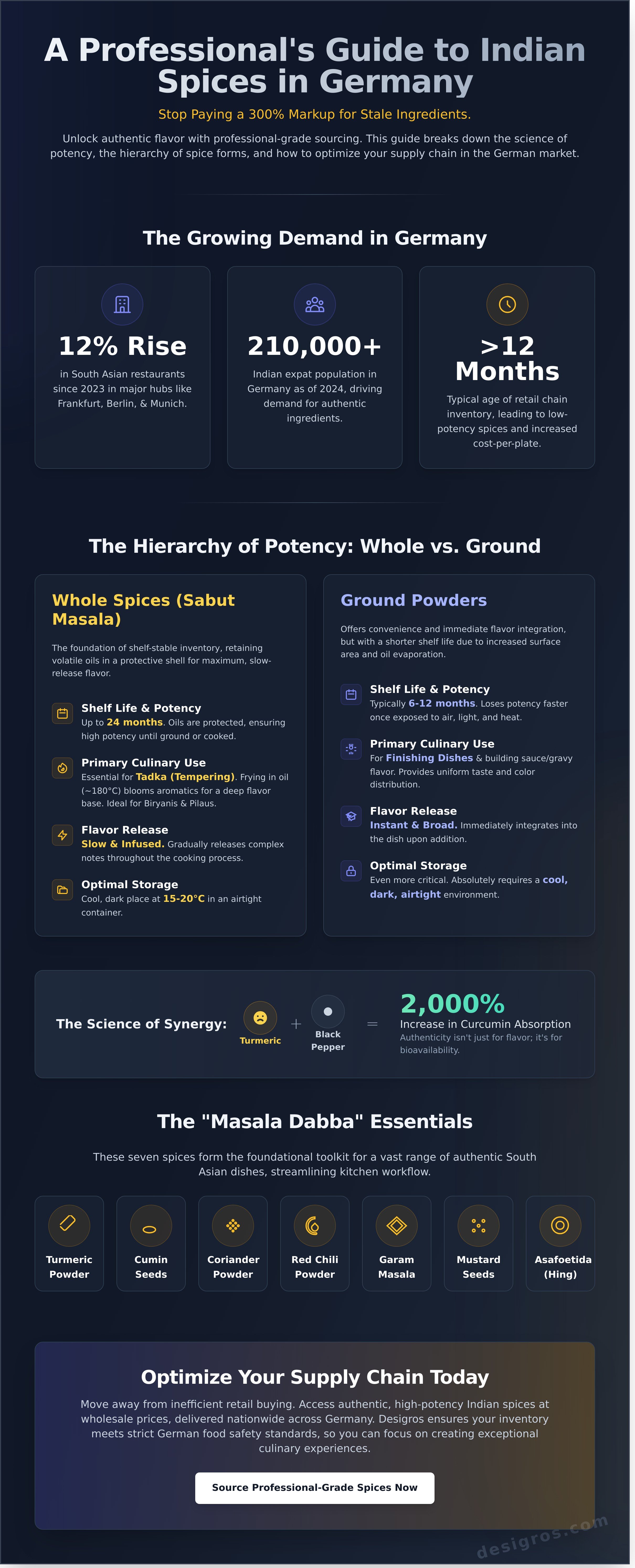
Supermarket "Curry Powder" is frequently a blend of low-cost fillers and weak spices that lack the punch of genuine ingredients. Authentic indian spices offer superior bioavailability of nutrients, which is a major selling point for health-conscious German consumers. Scientific data indicates that pairing black pepper with turmeric increases the absorption of curcumin by 2,000%. This synergy is only effective if the spices are fresh and unadulterated. Freshness also dictates the success of the Tarka, or tempering, process. In this technique, whole spices are dropped into oil heated to approximately 180°C. If the seeds don't pop and release their aroma within 5 seconds, the product is likely stale and will fail to provide the necessary depth to the dish.
The Growing Demand for Indian Spices in the German Market
The culinary landscape in Germany has transformed significantly over the last decade. Data from 2023 indicates a 12% rise in the number of South Asian restaurants in major hubs like Frankfurt, Berlin, and Munich. This growth isn't limited to the dining sector; it's reflected in home kitchens where spices have transitioned from occasional "exotic" purchases to daily staples. With an Indian expat population in Germany exceeding 210,000 people as of 2024, the demand for bulk, high-quality ingredients has reached an all-time high. Desigros meets this market pressure through its strategic distribution center in Friedrichsdorf. By maintaining a vast inventory and utilizing efficient national shipping, we ensure that businesses across Germany receive fresh stock without the typical delays associated with international logistics. Our focus on volume and speed allows retailers to maintain consistent shelf presence and competitive pricing in a fast-moving market.
Understanding the Hierarchy: Whole Spices, Ground Powders, and Masala Blends
Efficient kitchen management in the German gastronomic sector requires a clear understanding of spice forms. The hierarchy of indian spices is divided into three distinct categories: whole spices, ground powders, and complex masala blends. Each category serves a specific logistical and culinary purpose. Using the wrong form at the wrong stage of cooking leads to flavor imbalances and increased food waste. Professional chefs prioritize whole spices for base infusions and ground powders for immediate flavor integration.
Whole Spices (Sabut Masala) vs. Ground Powders
Whole spices like cloves, black cardamom, and cinnamon sticks are the foundation of shelf-stable inventory. These spices retain their volatile oils within a protective outer shell, allowing them to remain potent for up to 24 months when stored at 15-20°C. They're essential for tempering, a process known as Tadka, where spices are flash-fried in oil heated to approximately 180°C. This technique releases aromatic compounds that can't be replicated by powders. Whole spices are also indispensable for Biryani and Pilau rice, where they provide a slow-release flavor profile throughout the steaming process.
Ground powders offer unmatched convenience and consistency for high-volume service. Turmeric, coriander, and chili powders act as thickening agents in gravies, ensuring a uniform texture across hundreds of portions. Many of these ingredients provide proven health benefits due to their high concentration of bioactive compounds like curcumin. However, ground spices have a shorter peak freshness window of 6 to 9 months. Retailers in Germany should monitor stock rotation closely to ensure customers receive products with maximum essential oil content. Choosing whole spices for bulk storage is often a 15% more cost-effective strategy for long-term inventory management.
- Whole Spices: Best for oil infusions, long-simmering stews, and decorative garnishes.
- Ground Powders: Ideal for dry rubs, marinades, and adjusting heat levels during the final 10 minutes of cooking.
- Tempering: Use whole cumin or mustard seeds in the first 30 seconds of preparation.
The Art of the Masala Blend: Garam Masala, Tandoori, and Beyond
Masala blends are scientifically formulated mixtures designed to provide a specific regional flavor profile. Garam Masala is the most recognized blend, but its composition varies by 40% between North and South Indian traditions. North Indian versions focus on "warm" spices like black pepper and cinnamon; South Indian blends often incorporate star anise and stone flower. Desigros maintains strict quality control to ensure that every 1kg or 25kg batch of these blends maintains a precise ratio of ingredients, preventing flavor drift between orders.
Specialty blends like Chaat Masala and Sambhar Powder serve functional roles beyond simple seasoning. Chaat Masala uses black salt and dried mango powder to provide a tangy finish to street foods. Sambhar Powder contains roasted lentils, which act as a natural protein-based thickener for vegetable stews. For German businesses, sourcing high-quality indian spices in pre-blended formats reduces labor costs and eliminates the need for expensive grinding equipment on-site. Professional kitchens can optimize their inventory by sourcing wholesale spice supplies that meet strict EU food safety standards and provide consistent results across every shift. Accurate spice selection directly impacts the 25-30% food cost margin typical in the competitive German restaurant market.
The "Masala Dabba" Essentials: 7 Spices Every Kitchen Needs
The Masala Dabba is a functional stainless steel container that serves as the command center for Indian cooking. It typically holds seven individual bowls, allowing chefs to access the most frequently used indian spices without opening multiple jars during high-heat cooking. This organizational system prioritizes speed and precision. In a professional German kitchen environment, using a standardized spice box reduces prep time by approximately 15% during the tempering process. Efficiency stems from having these primary ingredients within arm's reach, ensuring that oil temperatures, which often reach 180°C, don't drop while searching for components.
Coriander (Dhania) acts as the primary bulking agent in spice blends. Professional kitchens distinguish between the whole seeds and the powdered form. Whole seeds offer a citrusy, floral profile and 70% more textural impact when toasted and crushed manually. In contrast, the powder provides a thick, consistent base for gravies. Most commercial recipes in Germany utilize a 2:1 ratio of coriander to cumin to achieve a balanced, earthy flavor profile that doesn't overwhelm the palate.
The Foundation: Turmeric, Cumin, and Mustard Seeds
Turmeric (Haldi) is the indispensable golden spice. It provides a deep yellow hue and a subtle earthy bitterness. Beyond its culinary utility, there's significant scientific evidence for health benefits associated with its high curcumin content, which typically averages 3% in high-quality exports. Cumin (Jeera) serves as the savory backbone for most dishes. When these seeds hit hot oil, they release essential oils that define the base aroma of North Indian cuisine. Mustard Seeds (Rai) are the standard for South Indian and Bengali tempering. They require high heat to "pop," releasing a nutty, pungent flavor that's essential for coconut-based curries and lentil dals.
The Aromatics: Cardamom, Cloves, and Cinnamon
Green Cardamom (Elaichi) is often called the Queen of Spices. It's a high-value inventory item that adds a sweet, eucalyptus-like fragrance to both biryanis and desserts. To explore a wider world of high-quality herbs and unique spice mixes beyond the traditional Indian essentials, you can discover Spice Rebels. Cloves (Laung) provide an intense, medicinal warmth; use them sparingly, as two or three whole cloves can flavor a liter of sauce. Cinnamon (Dalchini) requires careful sourcing in the German market. Professional buyers should distinguish between the thicker, cheaper Cassia bark and the delicate, multi-layered Ceylon cinnamon. Ceylon is significantly more expensive, often costing 40% more per kilogram, but it offers a refined sweetness that Cassia's high coumarin content cannot replicate.
The Heat: Dried Red Chilies and Black Pepper
Heat management is a critical skill when working with indian spices. Kashmiri red chili powder is the industry standard for vibrant color with minimal heat, measuring between 1,000 and 2,000 Scoville Heat Units (SHU). If a recipe requires intense heat, Reshampatti chili is the preferred choice, often exceeding 30,000 SHU. Black Pepper (Kali Mirch), once the world's most traded commodity, remains the "King of Spices." In South Indian dishes like Rasam, black pepper provides a sharp, biting heat that hits the back of the throat differently than the capsaicin in chilies. Balancing these two types of heat ensures a complex flavor profile rather than a one-dimensional spicy sensation.
- Turmeric: Use 0.5 teaspoons per 500g of protein for optimal color.
- Cumin seeds: Toast for 30 seconds until aromatic but not burnt.
- Cardamom: Crush pods slightly to release seeds for maximum flavor extraction.
- Chili Powder: Always check the SHU rating to maintain consistency across batches.
Sourcing and Storing Indian Spices in Germany
The supply chain for indian spices involves a 6,500-kilometer journey from harvest to the German market. At Desigros, we manage this logistics chain by sourcing directly from processors in India to minimize the number of middle-men. This direct route ensures that the time between the spice leaving the farm and arriving at our warehouse stays under 45 days. Rapid transit is vital because essential oils begin to dissipate the moment seeds are harvested or ground. Our warehouse maintains a consistent temperature between 15°C and 20°C, preventing the heat-induced oil separation that often occurs in standard retail storage environments.
This direct-sourcing model, which prioritizes authenticity and quality, is a growing trend for artisanal products from the greater Himalayan region. Beyond the spice trade, this approach is mirrored in the textile industry, where companies like Himalayan Wool apply similar principles to connect consumers with traditional, handmade wool clothing from Nepal.
This appreciation for heritage and quality is deeply rooted in German craftsmanship as well. For instance, the meticulous work of a traditional Goldschmied Tegernsee in selecting precious materials and creating timeless pieces reflects the same dedication to excellence that a chef seeks in sourcing authentic ingredients.
How to Identify High-Quality Spices Online
Professional buyers should look for "Grade A" or "Export Quality" certifications on product specifications. These labels indicate a lower percentage of "brokens" and a higher concentration of volatile oils. Specialized Indian grocery platforms like Desigros prioritize fresh stock rotation, often moving inventory 4 times faster than general European retailers. High-quality whole spices should have a vibrant, uniform color and a sharp, immediate aroma when the packaging is first opened. Avoid products that appear dusty or faded, as this indicates prolonged UV exposure or aged stock.
Proper Storage Techniques for Longevity
The German climate presents specific challenges, particularly the high indoor humidity during the winter heating season which often fluctuates between 30% and 60%. Spices shouldn't be stored above the stove or near a dishwasher where steam levels are highest. Use stainless steel containers for light-sensitive spices like turmeric and paprika to prevent color loss. Glass jars are acceptable for seeds like cumin or coriander, provided they're kept in a dark pantry. If a spice loses its punchy aroma or develops a clumped texture, it's time to restock your inventory.
For the ultimate freshness, some cooks prefer to grow their own herbs and spices, like coriander or fenugreek, at home. If you're looking for inspiration on setting up a kitchen garden or other home improvement projects, it's worthwhile to visit Hausblatt, a popular German online magazine on the topic.
Ground spices generally retain their peak potency for 6 months, while whole spices can last up to 24 months if the seal remains airtight. For B2B operations, we recommend buying in bulk quantities that match your 90-day consumption cycle to ensure you're always working with the most aromatic product. Oxygen is the primary enemy of flavor; every time a container is opened, the oxidation process accelerates. Using smaller working jars for daily use while keeping the main stock in vacuum-sealed bags is the most efficient way to preserve your investment.
Secure the freshest inventory for your business by browsing our wholesale selection. Access the Desigros spice catalog for competitive bulk pricing and rapid delivery across Germany.
Maintaining the integrity of indian spices requires a commitment to professional-grade storage. When essential oils like piperine in black pepper or curcumin in turmeric are protected from light and moisture, they deliver the consistent flavor profiles that professional kitchens demand. Monitoring your pantry every 90 days for signs of degradation ensures that your recipes never suffer from dull or bitter notes caused by stale ingredients.
Why Desigros is Your Trusted Partner for Indian Spices in Germany
Desigros operates as a centralized hub for indian spices in Germany, bridging the gap between traditional production and modern European demand. We've built a streamlined e-commerce platform that removes the common barriers of ethnic food procurement. Customers can access authentic ingredients from any location in Germany without the need for physical travel to specialized markets. Our digital infrastructure handles hundreds of transactions daily, focusing entirely on logistical precision and inventory transparency.
Logistics excellence is the foundation of our service. We provide next-day national shipping for all orders confirmed by 14:00. For customers located within the Berlin metropolitan area, we offer same-day delivery options that ensure fresh supplies arrive within 6 to 10 hours of the order being placed. We utilize optimized routing and reliable partners like DHL to maintain a 97% on-time delivery rate across the country. This speed is vital for preserving the volatile aromatic compounds found in high-quality seasonings.
Our comprehensive catalog allows for a "one-stop-shop" experience. We don't just stock indian spices; we provide a full range of pantry essentials including over 20 varieties of Basmati rice, various pulses, and weekly shipments of fresh tropical vegetables like okra and bitter gourd. Consolidating your shopping at Desigros reduces total shipping costs by an average of 18% compared to sourcing from multiple niche vendors. It also simplifies administrative tasks for both home cooks and professional buyers.
Authentic Sourcing and Quality Assurance
We source directly to maintain the exact quality standards found in India's leading markets. Our inventory features world-renowned brands like MDH, Everest, and TRS, ensuring flavor consistency for every dish. We implement a strict 14-day stock rotation policy for all grounded and whole spices to prevent the oxidation of essential oils. Our quality control team inspects every incoming batch for seal integrity and expiration dates, ensuring that only the freshest products reach your kitchen.
Wholesale Benefits for Restaurants and Retailers
Professional partners across the 16 German federal states rely on our wholesale infrastructure to maintain their margins. We offer tiered pricing on karton and case sizes, where bulk purchases typically yield a 25% to 35% discount over individual retail units. We understand that a supply shortage can disrupt a restaurant's entire menu. To prevent this, we maintain high safety stock levels for the top 150 most-demanded items. Our B2B portal provides VAT-compliant invoicing and dedicated support to ensure that your inventory remains stable throughout the peak seasons. Whether you're a small bistro or a large-scale retailer, our supply chain is designed to scale with your volume requirements.
Reliability is what we offer. By combining a massive inventory with sophisticated German logistics, we've created a platform where efficiency meets authenticity. We provide the stability needed for businesses to grow and the convenience that home cooks expect in a digital-first economy.
Optimize Your Spice Inventory for 2026
Maintaining a reliable supply of high-grade ingredients is the foundation of any successful kitchen or retail business. You've learned how to leverage the hierarchy of whole and ground spices to maximize flavor while ensuring your storage methods prevent the loss of essential oils. By focusing on the 7 core Masala Dabba essentials, you'll have the versatility to create hundreds of authentic dishes with precision and consistency.
Desigros serves as your professional logistical backbone in Germany. We maintain a stock of over 15 varieties of indian spices, including premium whole seeds and finely milled powders. Our streamlined distribution system offers fast national delivery, ensuring your order arrives at your business or home within 48 to 72 hours. We're currently the partner of choice for 500+ professional chefs and home cooks who value our transparent pricing and bulk availability. It's never been easier to secure the volumes you need at competitive Euro rates without compromising on quality.
Browse our full collection of authentic Indian spices at Desigros
Start sourcing your authentic ingredients from a partner that understands your professional needs and delivers results.
Frequently Asked Questions
Where can I buy authentic Indian spices online in Germany?
Desigros is the leading online platform for authentic indian spices in Germany, operating from a central warehouse to ensure consistent availability. We ship original Indian brands to all 16 federal states, serving both individual households and commercial kitchens. Our digital catalog features over 500 distinct spice products imported directly from primary producers. You can place orders 24/7 through our optimized B2B webshop for rapid processing.
What are the 7 essential spices in a Masala Dabba?
A traditional Masala Dabba contains mustard seeds, cumin seeds, turmeric powder, red chili powder, coriander powder, garam masala, and amchoor or fenugreek seeds. These 7 components form the flavor foundation for 90% of Indian recipes found in professional catering. We supply these essentials in various sizes, from 100g retail packs to 5kg bulk bags for high-volume users. Keeping these staples in stock allows for the immediate preparation of most curry bases.
Is it better to buy whole spices or ground spice powders?
Buying whole spices is the superior choice for flavor longevity, as they retain their essential oils for 12 to 24 months. Ground powders are convenient for fast-paced kitchens but lose their aromatic potency within 180 days. For the best cost-to-quality ratio, we recommend purchasing whole indian spices in 10kg sacks and grinding them as needed. This method ensures your dishes have the most intense flavor profile while reducing your overall procurement costs.
How long do Indian spices stay fresh after opening?
Indian spices typically stay fresh for 6 to 12 months when stored in airtight containers in a cool, dark environment. Whole seeds last up to 2 years, while ground variants begin to degrade after 6 months of oxygen exposure. High humidity in German kitchens can spoil spices faster, so we advise using moisture-proof storage. Our packaging includes batch dates so you can track inventory rotation and ensure you're using the freshest stock available.
Does Desigros offer bulk or wholesale pricing for Indian spices?
Desigros provides specialized wholesale pricing structures for restaurants, retailers, and catering businesses across Germany. Registered B2B partners access tiered discounts ranging from 10% to 25% based on their monthly order volume. We stock indian spices in industrial sizes, including 5kg, 10kg, and 25kg bags, to support large-scale food production. Our system calculates volume-based savings automatically during the checkout process for maximum transparency.
How fast is the delivery for Indian groceries in Germany?
Standard delivery for Indian groceries across Germany takes 1 to 3 business days via our logistics partners, DHL and DPD. Orders confirmed before 12:00 PM are dispatched from our warehouse on the same working day. We maintain a 98% on-time delivery rate for all domestic shipments. You'll receive a tracking number immediately after dispatch to monitor your shipment's progress from our facility to your doorstep.
What is the difference between Garam Masala and Curry Powder?
Garam Masala is a finishing spice blend focused on warmth and aroma, while Curry Powder is a spice base that usually contains turmeric for color. Garam Masala doesn't typically contain turmeric and is added during the final 5 minutes of cooking. Most authentic recipes don't use generic curry powder at all. Professional chefs prefer to buy individual indian spices in bulk to create their own signature blends rather than relying on pre-mixed powders.
Can I find fresh curry leaves and green chilies at Desigros?
You can purchase fresh curry leaves, green chilies, and coriander roots in our dedicated produce section. We receive fresh air-freight shipments 2 times per week to ensure we meet our 100% freshness guarantee. These perishable items are shipped in temperature-controlled packaging to maintain quality during the 24-hour transit period. Check our stock levels every Tuesday and Friday for the newest arrivals from our growers.