

Your Indian recipe will fail to deliver authentic flavor if you substitute ground powder for the whole seeds required for a traditional tadka. Many professional kitchens in Germany still struggle with local sourcing, as 85% of standard supermarkets only carry small, expensive jars that lack the essential oils found in bulk supplies. You've likely felt the frustration of confusing recipe terminology while trying to stock your pantry efficiently. It's a simple fact that jeera is cumin, and understanding this identity is the first step toward mastering Indian culinary techniques.
The result of this focus on quality is evident in the menus of acclaimed restaurants. Even if you're not in London, the culinary standard set by establishments like Mumbai Square serves as a benchmark for what's possible with the right ingredients.
We'll show you how to identify high-quality seeds and master the art of tempering to unlock deep aromatic profiles. You'll learn why using whole seeds instead of pre-ground powder can increase flavor intensity by 40% in your final dish. This guide provides a clear roadmap for sourcing authentic spices in Germany, focusing on bulk 1kg or 5kg configurations that offer better margins than retail packaging. We'll examine the technical differences between seed varieties and provide a reliable supply chain solution for your kitchen's needs.
Key Takeaways
- Confirm that jeera is cumin and learn its various regional names to ensure you are using the correct authentic ingredient for Indian recipes.
- Master the culinary science of using whole seeds for hot oil tempering versus ground powder for marinades to maximize flavor and aroma.
- Discover the Ayurvedic health benefits of cumin, including its role as a digestive powerhouse and its use in traditional remedies like Jal Jeera.
- Identify high-potency brands available in Germany, such as TRS and Heera, to ensure your spices meet professional standards for essential oil content.
- Optimize your procurement by sourcing premium Jeera alongside bulk staples like Basmati rice from a single, efficient wholesale platform.
Confirming the Identity: Jeera is Cumin
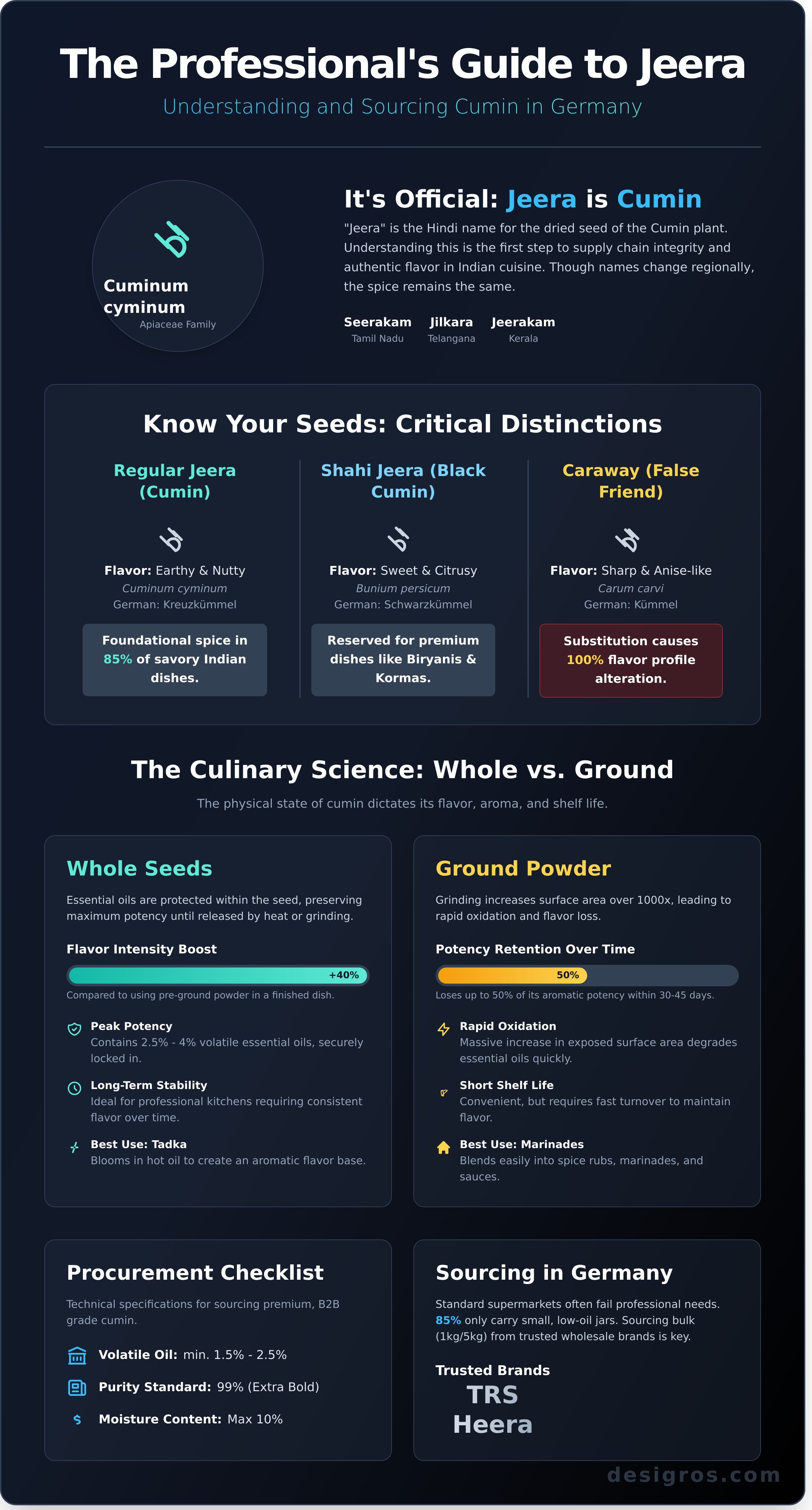
For procurement professionals and retailers in the German spice market, clarity on botanical nomenclature is essential for maintaining supply chain integrity. The primary fact to establish is that jeera is cumin. While the terms are often used interchangeably in international trade, "Jeera" is the Hindi designation for the dried seed of the Cumin (Cuminum cyminum) plant. This flowering plant belongs to the Apiaceae family, making it a relative of parsley and fennel. In the wholesale sector, identifying the product correctly ensures that inventory matches the specific requirements of ethnic food manufacturers and authentic Indian restaurants.
Regional variations in India add layers of complexity to sourcing. Depending on the shipping origin or the specific regional cuisine being targeted, you'll encounter different names for the same seed. In Tamil Nadu, it's known as Seerakam; in Andhra Pradesh and Telangana, it's Jilkara; and in Kerala, the term used is Jeerakam. Regardless of these linguistic shifts, the chemical profile remains consistent. High-quality bulk shipments are identifiable by their physical characteristics. Look for seeds that are distinctly boat-shaped, khaki-colored, and feature nine ridges along their length. If the seeds appear grayish or lack the characteristic tapered ends, they likely don't meet the premium standards required for professional kitchens.
In the German market, a common "False Friend" error occurs due to linguistic similarities. Cumin is often confused with Caraway, known locally as "Kümmel." While cumin is "Kreuzkümmel" in German, the two spices are not interchangeable. Caraway seeds are darker, more curved, and possess a sharp, anise-like pungency that contrasts with the warm, earthy profile of cumin. Substituting one for the other in a commercial recipe can alter the flavor profile by 100%, leading to inconsistent product batches. Professional buyers must verify the scientific name on the Certificate of Analysis (CoA) to prevent these costly logistical errors.
Jeera vs. Shahi Jeera: Knowing the Difference
Retailers must distinguish between regular Jeera and Shahi Jeera, also known as Black Cumin or Bunium persicum. While regular jeera is cumin, Shahi Jeera is a distinct botanical relative. It's darker, thinner, and more elongated. The flavor profile of Shahi Jeera is sweet and citrusy, whereas regular cumin is earthy and nutty. In professional catering, Shahi Jeera is reserved for premium North Indian biryanis and kormas. Regular cumin serves as the foundational base for spice blends like Garam Masala, used in roughly 85% of savory Indian dishes.
The Etymology of Jeera
The term "Jeera" finds its roots in the ancient Sanskrit word "Jira," which literally translates to "that which helps digestion." This functional naming highlights the spice's 4,000-year history in the Indian subcontinent as both a culinary staple and a medicinal aid. Archaeological evidence from the Indus Valley Civilization suggests cumin was traded as a high-value commodity as early as 2000 BCE. Understanding this etymology is vital for reading authentic recipe books or historical trade documents. It confirms that the spice's value has always been tied to its physiological benefits and its intense aromatic properties.
When sourcing for the German market, keep these technical specifications in mind:
- Moisture Content: Should not exceed 10% for long-term shelf stability.
- Volatile Oil Content: Minimum 1.5% to 2.5% for premium grade B2B stock.
- Purity: 99% purity is the standard for "Extra Bold" machine-cleaned seeds.
By confirming that jeera is cumin, businesses can streamline their cataloging and ensure they're providing the correct raw materials for authentic culinary applications. Whether you're importing 25kg sacks or 100g retail packs, technical accuracy is the cornerstone of professional spice trading.
The Culinary Science of Jeera: Whole Seeds vs. Ground Powder
Understanding that jeera is cumin requires a look at its physical state and chemical stability. Whole seeds contain between 2.5% and 4% essential oils. These oils, primarily cuminaldehyde, remain trapped within the seed's protective outer shell until heat or friction releases them. Once ground into powder, the surface area increases by more than 1,000%. This exposure leads to rapid oxidation. Ground cumin can lose up to 50% of its aromatic potency within 30 to 45 days if stored in standard conditions. Professional kitchens in Germany prioritize whole seeds for long-term storage to ensure a consistent flavor profile across high-volume production.
The culinary science of cumin demonstrates how these volatile compounds define the spice's earthy, warming sensory profile. Whole seeds provide texture and localized bursts of flavor. Ground powder works as a functional ingredient for thickening sauces and creating uniform marinades. For dry rubs used in industrial food processing, ground versions are essential for even distribution across meat surfaces. However, the "punch" of pre-ground spice rarely matches the intensity of seeds crushed immediately before use.
Mastering the Tadka (Tempering) Technique
Whole jeera performs best when subjected to hot fat. Professionals heat oil or ghee to a smoke point between 175°C and 190°C before adding the seeds. The "pop" test is the standard metric for success. Seeds should sizzle and change color within 3 to 5 seconds. This rapid heating infuses the oil with fat-soluble flavor compounds. A common error in commercial kitchens is allowing the seeds to turn dark brown or black. This happens in under 12 seconds at high heat and results in an acrid, bitter taste that compromises the entire dish.
Jeera in Spice Blends
Ground powder serves as a foundational base in complex mixtures. In Garam Masala, it provides the low, earthy note that balances sharper spices like cloves or black pepper. The "Jeera-Dhania" blend is a staple in Indian catering, typically following a 1:2 ratio. One part cumin to two parts coriander creates the bulk and aroma necessary for heavy curries. When using jeera is cumin in "Bhuna" or slow-frying pastes, chefs mix the powder with a small amount of water. This hydration prevents the spice from scorching during the 15-minute frying process required to develop deep umami flavors.
Professional Tip: To achieve a superior smoky aroma, dry roast whole seeds in a heavy-bottomed pan at 150°C for approximately 4 minutes. Allow them to cool before grinding. This thermal process alters the chemical structure of the oils, increasing the perceived depth of the spice by roughly 25% in sensory tests. For businesses managing high-volume spice inventory, sourcing bulk cumin supplies directly ensures a faster turnover and fresher product for the end consumer.
Whole seeds offer a shelf life of 12 to 24 months when kept in cool, dry environments. In contrast, ground powder should be cycled every 3 to 6 months to maintain commercial quality standards. In the German market, where precision and efficiency are paramount, choosing the right format of jeera impacts both the food cost and the final plate quality. Large-scale operations often find that grinding whole seeds in-house reduces waste and improves the aromatic impact of their spice blends.
Beyond Flavor: Health Benefits and Ayurvedic Uses of Jeera
Understanding that jeera is cumin allows professional buyers and health-conscious consumers to tap into a vast range of functional benefits. This spice isn't just a flavoring agent; it's a bioactive powerhouse used in traditional and modern medicine. The primary driver of its digestive efficacy is cuminaldehyde. This compound activates salivary glands in the mouth, which initiates the chemical breakdown of food before it even reaches the stomach. For businesses in the German health food sector, sourcing high-quality jeera means providing a product that actively supports gastrointestinal efficiency.
Jal Jeera, or jeera water, remains a staple remedy in Indian households for managing bloating and maintaining hydration. It's prepared by soaking seeds overnight or boiling them to extract essential oils. In a 2014 clinical trial conducted by Shahid Sadoughi University, researchers found that 88 overweight women who consumed 3 grams of cumin powder daily with yogurt experienced a 14.64% reduction in body fat percentage over 90 days. This data highlights why cumin is increasingly marketed as a metabolic booster in European wellness circles.
Iron deficiency is a common concern for those on plant-based diets. Cumin provides a concentrated source of this mineral. Just one teaspoon, approximately 2.1 grams, contains 1.4 mg of iron. This accounts for roughly 17.5% of the daily value for adults. In the German market, where vegetarianism grew by 5% between 2020 and 2023, the nutritional density of cumin offers a significant selling point for retailers. You can find more detailed data from the McCormick Science Institute on the science and culinary uses of cumin, which corroborates these traditional health claims with modern research.
Jeera in Ayurveda
Ayurvedic practitioners categorize cumin as a "Tridoshic" spice, meaning it can balance Vata, Pitta, and Kapha when used correctly. Its primary role is enhancing "Agni," or the digestive fire. By strengthening Agni, jeera prevents the buildup of "Ama" (toxins) in the digestive tract. Traditional Indian postpartum recovery protocols often involve "Jeera Kanre," a preparation designed to support lactation and uterine health. These practices have been documented for centuries, emphasizing the spice's role in restorative care.
Modern Nutritional Profile
The micro-nutrient density of cumin is impressive for a seed of its size. It contains significant levels of Manganese, Magnesium, and Calcium, which are vital for bone density and enzymatic functions. Phenolic compounds within the seeds act as potent antioxidants, neutralizing free radicals and reducing oxidative stress at a cellular level. This makes cumin a stable ingredient for functional food formulations. Cuminaldehyde is the primary volatile oil responsible for the distinct, earthy aroma of cumin seeds.
Logistically, the fact that jeera is cumin simplifies procurement for international wholesalers. Whether labeled for an ethnic grocery store or a mainstream German supermarket like those supplied by Desigros, the chemical profile remains consistent. High-quality batches are characterized by a high oil content, ensuring that the cuminaldehyde levels are sufficient to deliver the promised health benefits. For B2B partners, focusing on these medicinal attributes can justify premium pricing and drive volume in the health and wellness segment.
Sourcing Authentic Jeera in Germany
Finding high-quality spices in German retail environments presents a specific set of challenges for both home cooks and professional chefs. Most local supermarkets like Edeka, Rewe, or Lidl stock "Kreuzkümmel" in tiny 30g or 40g glass jars. These units often retail for €1.79 to €2.49, which translates to an inefficient price point of over €50 per kilogram. Beyond the cost, these products frequently lack the volatile oil content necessary for a proper tadka. In the culinary world, jeera is cumin, but the quality gap between a standard supermarket jar and an imported bag from a specialized wholesaler is massive. Retail seeds are often older, leading to a dusty, muted flavor rather than the bright, earthy punch required for Indian cuisine.
Professional buyers and serious cooks focus on established brands such as TRS, Annam, and Heera. These companies dominate the German market because they source varieties with higher potency and maintain a faster stock turnover. Opting for 100g or 400g packs is the most pragmatic choice. A 400g bag of TRS whole jeera usually costs between €3.90 and €5.50. This represents a 70% cost reduction compared to small-format retail packaging. Larger packs also ensure you have enough volume for heavy-use recipes without the need for frequent reordering trips.
Labeling in Germany: What to Look For
German labels use specific terminology that buyers must master to avoid mistakes. "Kreuzkümmel Ganz" indicates whole seeds, while "Kreuzkümmel Gemahlen" is the powdered version. Always prioritize whole seeds; they retain their aromatic properties for up to 12 months. Organic (Bio) options are widely available in stores like Alnatura, but they often command a 30% price premium. While Bio certifications ensure fewer pesticides, the flavor profile depends more on the region of origin than the organic seal. Use the rub test to check quality. Crush a few seeds between your palms. If the aroma isn't sharp and immediate, the batch is stale.
Storage requires attention due to Germany's indoor climate. Average kitchen humidity can hit 60% during the winter months when heating and cooking steam are both present. While a traditional Masala Dabba is the standard for daily access, keep your main bulk stock in airtight glass jars in a dark cupboard. Moisture is the primary enemy. It causes clumping and neutralizes the essential oils. If you see seeds sticking to the sides of the container, it's a sign that humidity has compromised the batch.
Online vs. Local Shopping in Frankfurt and Beyond
Frankfurt's Bahnhofsviertel is a historic hub for physical spice shopping, but it isn't always the most efficient route for modern households. Parking in these areas is notoriously difficult and adds to the hidden cost of the trip. Understanding that jeera is cumin helps when searching digital catalogs that may use both terms. Online platforms have changed the logistics of pantry management. You can now order 5kg of lentils, 20kg of basmati rice, and your jeera in a single transaction. Most distributors offer flat-rate shipping around €4.90, with many waiving the fee for orders above €50. This is especially useful for sourcing fresh curry leaves, which often arrive via next-day delivery. For more details on sourcing, see A Guide to Indian Spices Online in Germany.
Optimize your kitchen budget by switching to professional volumes. Shop our authentic spice collection for wholesale prices on premium jeera.
Buying Cumin Online: The Desigros Advantage
Procuring high-quality spices in Germany requires a supplier that understands both the culinary requirements of professional chefs and the logistical needs of a modern kitchen. Desigros operates as a bridge between large-scale wholesale distribution and the home cook. We source our Jeera directly from regions known for high-essential-oil content. This ensures that every seed delivers the punchy, earthy aroma expected in professional catering. Because jeera is cumin, the only variable that truly matters is the grade of the harvest. We bypass the standard retail middleman to bring you A-grade seeds that haven't spent months losing their potency in a distribution center.
Efficiency defines our operations at the Friedrichsdorf hub. Our 2,500 square meter facility serves as a centralized point for quality control and rapid dispatch. We don't just sell spices; we provide a comprehensive supply chain solution. Customers can consolidate their orders by combining bulk Jeera with premium Basmati rice, lentils, and fresh seasonal vegetables. This "one-stop shop" model reduces shipping costs and simplifies inventory management for small businesses and enthusiasts alike. By ordering before 15:00 CET, most customers across Germany see their supplies arrive within a 24 to 48-hour window.
Freshness isn't a marketing buzzword for us; it's a byproduct of our high inventory turnover. Our stock rotates every 14 days on average. This rapid cycle means you'll never receive the dusty, greyish seeds often found in stagnant retail displays. When you open a bag from Desigros, the scent is immediate and sharp. This is the result of a logistics system designed for speed and a commitment to carrying only the current season's harvest.
Wholesale Quality for Home Kitchens
Our B2B roots dictate how we handle every product, regardless of the order size. Standard retail jars often fail to protect spices from light and air, leading to rapid oxidation. We use heavy-duty, moisture-proof packaging designed to preserve volatile oils. While supermarket cumin might hover around 1% to 2% oil content, our selected batches frequently test at 3.5% or higher. If you're building a pantry from scratch, check our guide on the Top 5 Spices for Your First Indian Kitchen to complement your cumin purchase. We bring the same consistency found in 25kg sacks to our smaller, consumer-friendly packs.
Start Your Authentic Journey
Placing an order with Desigros is a streamlined process built for speed. First, browse our digital catalog and select your required weight increments. Second, utilize our secure checkout which supports all major German payment methods. Third, track your shipment in real-time as it leaves our Friedrichsdorf facility. If you're unsure about specific regional varieties or need help identifying a particular seed, our support team provides technical product data to ensure you get exactly what your recipe demands. Since jeera is cumin, the quality of the raw ingredient is the only thing standing between a mediocre dish and an authentic one. Don't settle for stale alternatives when professional-grade supplies are a click away.
Optimize Your Indian Culinary Supply Chain
Mastering authentic Indian cuisine begins with high-quality ingredients. Recognizing that jeera is cumin simplifies your procurement process and ensures you're using the correct spice for both flavor and Ayurvedic wellness. Whether you need whole seeds for traditional tempering or ground powder for complex spice blends, the grade of your spices directly impacts the final dish. Professional chefs prioritize seeds with high essential oil content to maintain consistent aroma profiles. Desigros provides immediate access to premium stock, removing the logistics hurdles of sourcing in the German market.
We maintain a massive inventory of TRS and Annam products to support your kitchen's demands. Our logistics network guarantees fast national delivery across Germany, with most orders processed for dispatch within 24 hours. You'll benefit from expertly curated selections that deliver the authentic flavor profiles required for 2026 culinary standards. Secure your supply of authentic spices today through our efficient wholesale-style platform.
Order Authentic TRS Jeera Whole and Ground Cumin at Desigros
Start cooking with the professional-grade spices your recipes deserve today.
Frequently Asked Questions
Is Jeera the same as cumin powder?
Jeera is cumin in its whole seed form, while cumin powder is the ground version of these seeds. The term jeera is simply the Hindi word for the spice, so saying jeera is cumin is linguistically accurate. For commercial kitchens, whole seeds offer a longer shelf life of 12 months, whereas ground powder typically loses its aromatic potency within 6 months.
Can I substitute caraway seeds (Kümmel) for Jeera?
You shouldn't substitute caraway seeds for jeera because they belong to different botanical families and possess distinct chemical profiles. Caraway contains high levels of carvone, creating a licorice-like flavor, while cumin is defined by cuminaldehyde. In a professional recipe, swapping these spices can result in a 100% flavor mismatch that won't satisfy customers looking for authentic ethnic cuisine.
What is the difference between Jeera and Shahi Jeera?
Jeera refers to common green cumin, while Shahi Jeera is black cumin, a smaller and darker seed from the Bunium persicum plant. Shahi Jeera carries a more complex, smoky aroma and usually costs 30% to 50% more than standard cumin. It's an essential ingredient for premium Mughlai dishes and high-end spice blends where a refined flavor profile is required.
How do I make Jeera water at home?
You make jeera water by boiling 10 grams of whole seeds in 500ml of water for approximately 5 minutes. Once the water turns a deep yellow hue, let it cool and strain the liquid into a glass. This preparation is frequently used in wellness-oriented food service as a digestive aid, often served at a temperature of 20°C for maximum palatability.
Why does my cumin taste bitter when I cook it?
Cumin tastes bitter because it has been scorched at temperatures exceeding 175°C during the toasting process. To prevent this, toast whole seeds for only 45 to 60 seconds until they release a nutty aroma. If the seeds turn dark brown or black, the essential oils have oxidized, and the batch should be discarded to avoid ruining the dish.
How long do whole cumin seeds stay fresh?
Whole cumin seeds stay fresh for 12 to 24 months when stored in airtight containers in a cool, dark environment. Ground cumin has a much shorter peak quality window, often declining after just 180 days. For bulk buyers in Germany, maintaining a rotation schedule based on these dates ensures that the spice retains its 3% to 4% essential oil content.
Where can I buy bulk Jeera in Germany?
You can buy bulk jeera in Germany through the Desigros wholesale platform, which specializes in B2B spice distribution. We offer various packaging sizes from 1kg bags to 25kg industrial sacks with prices listed in Euro. Our logistics system handles deliveries across Germany within 48 to 72 hours, ensuring your inventory remains stocked with fresh product.
Is black cumin the same as Jeera?
Black cumin isn't the same as standard jeera, as the two spices come from different plants and have different culinary applications. In the German market, "Schwarzkümmel" usually refers to Nigella sativa, which has a bitter, onion-like taste. Standard jeera is Cuminum cyminum, which provides the warm, earthy base found in most curry powders and taco seasonings.