

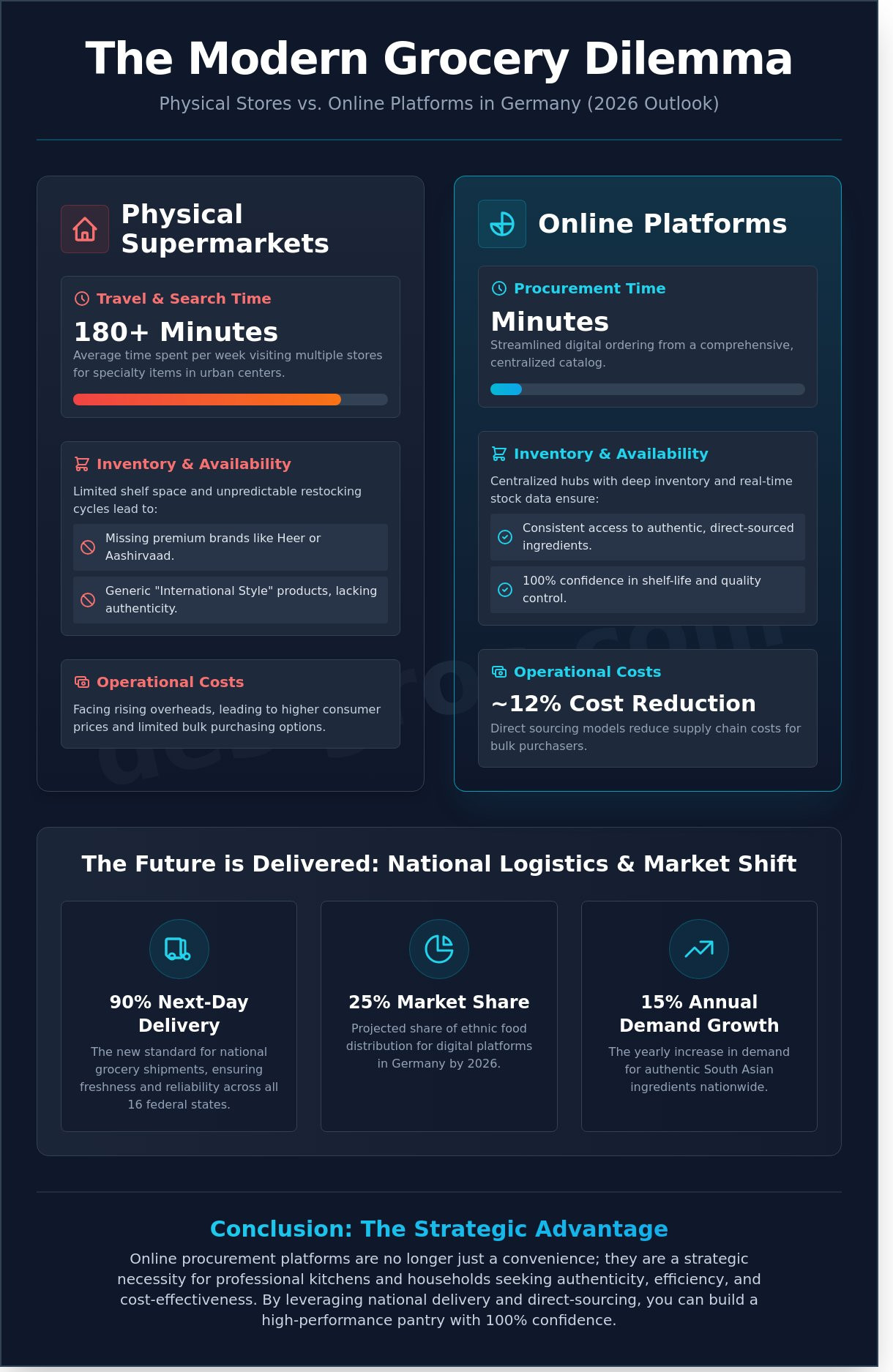
Relying on local supermarkets for specialty ingredients often wastes over 180 minutes of travel time per week for residents in Germany's urban centers. You've likely experienced the inefficiency of visiting three different physical stores only to find that premium brands like Heer or Aashirvaad are missing from the inventory. It's a logistical bottleneck that affects households across all 16 federal states. Finding a reliable grocery source shouldn't depend on the unpredictable restocking cycles or limited shelf space of a single neighborhood retailer.
We agree that consistent access to high-quality staples is the foundation of a professional-grade kitchen. This guide provides a strategic framework to master your shopping by blending national delivery efficiency with authentic global sourcing. You'll learn how to secure bulk staples and maintain 100% confidence in the shelf-life of your imported goods. We'll examine how streamlined procurement ensures your pantry remains stocked with premium ingredients while reducing your monthly procurement costs through optimized supply chain solutions.
Key Takeaways
- Understand how the 2026 German grocery landscape bridges the gap between local digital convenience and authentic South Asian ingredients.
- Master the professional categorization of essential staples like grains, pulses, and spices to build a high-performance kitchen inventory.
- Evaluate the logistical advantages of online procurement platforms over physical markets to maximize inventory depth and reduce operational time.
- Learn how to streamline your supply chain with national delivery solutions that bring direct-sourced global products to any location in Germany.
The Evolution of Grocery Shopping in Germany: Local Needs and Global Flavours
The German grocery market is undergoing a structural transformation. By 2026, digital procurement and automated logistics will define how households and businesses source ethnic staples. Consumers no longer settle for the limited "International Food" aisles found in major supermarket chains in Germany. Instead, there's a shift toward specialized digital platforms that provide direct access to global supply chains. This evolution is driven by a 15% annual increase in demand for South Asian ingredients across the nation. These products have moved from niche ethnic markets to a national priority for both households and professional kitchens. Professional logistics now bridge the "availability gap" that once restricted authentic ingredients to specific urban centers.
The Shift from Local Markets to National E-commerce
Small, regional physical stores face rising overhead costs and limited shelf space. Centralized distribution hubs now dominate the landscape. These hubs utilize professional logistics to offer same-day or next-day shipping across Germany. Professional buyers and bulk purchasers prioritize these online inventories because they offer real-time stock data. You won't find the same depth of variety in a physical store that you can access through a centralized digital catalog. This transition ensures that even remote areas have consistent access to high-quality pantry essentials. The focus has shifted from physical browsing to logistics-led efficiency. Online platforms provide the scalability that local shops simply can't match.
The Importance of Authenticity in Modern Sourcing
There's a clear distinction between "International Style" products and those of "Authentic Origin." Mass-market retailers often carry generic versions of spices and nuts that lack the specific flavor profiles required for traditional South Asian cuisine. Desigros addresses this by implementing a direct sourcing model. This is especially evident in our supply of premium badam almonds, where we maintain strict quality controls from the source. By bypassing multiple middle-men, we ensure the cultural integrity of our catalog stays intact. Our inventory management focuses on commercial stability, providing businesses with the exact specifications they need for their operations. This approach eliminates the risk of receiving substandard substitutes that compromise the final dish's quality. We prioritize volume and reliability to support the growing grocery needs of the German market.
- 2026 Projection: Digital platforms will account for 25% of ethnic food distribution in Germany.
- Logistics: Next-day delivery is now the standard for 90% of national shipments.
- Direct Sourcing: Reduces supply chain costs by approximately 12% for bulk buyers.
Decoding Essential Grocery Categories for a Professional Kitchen
Efficient kitchen management starts with precise inventory categorization. The online grocery e-retail market in Germany saw a 15% growth in 2023, reflecting a shift toward digital procurement for professional food services. Professionals divide their pantry into four core pillars: grains, flours, pulses, and spices. This structure allows for better stock rotation and cost control. Handling "Fresh Indian Vegetables" like okra or bitter gourd in Germany requires a specialized supply chain. National delivery providers now use temperature-controlled logistics to maintain a 24-hour to 48-hour transit window, ensuring produce arrives without wilting.
The rise of high-quality frozen technology has changed how kitchens operate. Individually Quick Frozen (IQF) methods preserve the cellular integrity of vegetables and ready-to-eat meals, providing a 12-month shelf life without sacrificing taste. Dairy management is equally critical. Temperature-sensitive items like Paneer require a consistent 4°C cold chain from the warehouse to the kitchen door. Any fluctuation in these logistics can lead to immediate inventory loss, making reliable wholesale partners essential for maintaining profit margins.
Grains and Flours: The Foundation of the Pantry
Distinguishing between rice varieties is a prerequisite for authentic results. Long-grain Basmati rice is reserved for biryanis and pilafs due to its distinct aroma and elongation. Non-Basmati varieties like Sona Masoori or Ponni are better suited for daily canteen use or South Indian staples. For bread making, professionals prioritize high-protein Whole Wheat Atta. A protein content of 12% or higher ensures the elasticity needed for soft chapatis. Specialized kitchens also stock semolina for regional dishes like Rava Dosa, where texture and granulation size are non-negotiable.
Spices and Condiments: Building Flavour Profiles
Professional kitchens prioritize whole spices over pre-ground versions to ensure maximum oil retention. Volatile oils responsible for flavor dissipate quickly once the spice is ground; therefore, grinding in-house before service provides a superior sensory profile. Blended spices, or Masalas, are used for consistency across large batches. Condiments play a strategic role in plate economics. Integrating pickles (achar) into a meal structure adds complex acidity and spice for a low per-portion cost. These fermented additions enhance simple rice and lentil dishes, increasing perceived value for the customer.
Beyond spices, a well-rounded professional pantry often includes high-quality beverages. For those sourcing premium, ethically-sourced coffee from specific regions like Brazil, online specialists such as cafedelicioso.com provide direct access to authentic beans.
You can browse our current wholesale grocery inventory to find bulk pricing on these essential categories.
Comparing Physical Markets vs. Online Grocery Platforms in 2026
Physical grocery procurement in Germany is undergoing a structural shift. By 2026, the average urban consumer spends approximately 52 minutes on a round-trip to a specialty market, accounting for traffic and parking. In contrast, digital ordering on a professional platform takes less than 5 minutes. This efficiency audit shows that online systems save over 45 hours annually for the average household. Online warehouses outperform physical shelves because they aren't limited by retail floor space. A typical physical store carries 1,500 to 3,000 items; a centralized digital warehouse often manages over 15,000 SKUs, ensuring that specific lentil varieties or regional rice brands are always available.
The financial math favors the digital model when analyzing overhead. Fuel prices in Germany remain high, often hovering around €1.85 per liter. Combined with city parking fees that can reach €4.00 per hour in Berlin or Munich, the hidden costs of a physical trip frequently exceed the standard €5.90 shipping fee. Bulk purchasing offers the most significant advantage. Buying 10kg or 20kg sacks of Basmati rice and wholesale-sized lentil packs reduces the price per kilogram by 18% to 25% compared to small-format retail packaging. This wholesale-style approach, once reserved for restaurants, is now the standard for cost-conscious households.
Logistics and Reliability Across Germany
Professional logistics have evolved to protect fragile inventory. Desigros utilizes industrial-grade packaging to ensure glass jars and fresh produce arrive intact. Every shipment follows the B2B standard, providing 100% tracking transparency from the warehouse to your door. This reliability explains why online delivery is the new local standard for both rural regions and dense urban centers. You no longer need to live near a metropolitan hub to access high-quality Indian staples.
Range and Specialization
Physical grocery stores near me rarely stock niche items like specific Urad Dal splits or premium aged Sona Masoori rice. Online platforms provide a "One-Stop Shopping" experience where dry pantry goods, fresh vegetables, and frozen items are consolidated into a single order. Centralized inventory management ensures better stock rotation than local shops. This system results in fresher products, as goods move directly from import containers to the consumer without sitting on retail shelves for weeks. This grocery model prioritizes volume and turnover, guaranteeing the highest quality for your Indian pantry.
The Practical Guide to Building Your Professional Pantry
Efficient pantry management requires a systematic approach to inventory and procurement. Start by auditing your core dietary needs to determine if your operations are Rice or Atta dominant. Most Indian-focused kitchens in Germany allocate 65% of their dry storage to one of these two pillars. It's a simple calculation that prevents overstocking. Identify items as either "Long-Life" or "High-Turnover" to optimize space. Lentils and rice fall into the long-life category; they remain stable for 12 to 24 months. Fresh dairy and greens are high-turnover goods that need weekly replacement. Establishing a quarterly bulk-buy routine for dry staples reduces your grocery overhead by approximately 18% annually. Buying in 20kg units instead of 1kg retail packs stabilizes your supply chain. Integrate fresh and frozen cycles to ensure a 30% fresh-to-dry ratio for balanced nutrition. Storage solutions must adapt to the German climate, where indoor humidity fluctuations between 30% and 65% impact grain integrity throughout the year.
Storage and Shelf-Life Management
To maintain bulk Basmati rice quality in German kitchens, keep the storage area at a relative humidity level below 55% at all times. Whole wheat atta is highly susceptible to moisture and pests like flour beetles. Store your atta in food-grade, airtight bins and use the "First-In, First-Out" (FIFO) method to ensure freshness. Oxygen absorbers can extend the shelf life of sealed flour by an additional 6 months. Spices require protection from heat and light to preserve essential oils like piperine and curcumin. Organize your spice rack in a dark cupboard away from the stove. Temperatures exceeding 25°C rapidly diminish potency and flavor profiles; this leads to higher spice consumption to achieve the same taste results.
Sourcing Fresh vs. Frozen Produce
Frozen grated coconut is the superior choice for high-volume cooking. It eliminates the 20-minute extraction and grating process required for fresh nuts. During the peak national season from April to June, prioritize fresh Indian mangoes like Alphonso or Kesar for premium desserts. These varieties offer a brix level (sugar content) that frozen pulp cannot match. For professional catering or hosting, ready-to-eat frozen samosas provide a 40% reduction in labor costs. These frozen options allow for rapid scaling during peak demand periods without increasing kitchen staff requirements. Using frozen grocery items ensures portion control and reduces food waste by 15% compared to scratch-made equivalents during busy periods.
Of course, preparing for special occasions often goes beyond food. For those seeking timeless gifts that reflect a similar commitment to quality and tradition, you can discover Juwelier Risch, a family-run master jeweler in Germany.
Maximize your procurement efficiency by browsing our wholesale grocery catalog for bulk pricing on premium staples.
Desigros: Streamlining National Grocery Delivery Across Germany
Desigros operates as a high-volume logistics hub focused on reliability and speed. We source our inventory directly from the Indian subcontinent to eliminate unnecessary middleman costs. Since January 2024, our distribution network has expanded to cover all 16 German states, ensuring that professional-grade ingredients reach every zip code. We apply a B2B efficiency model to every order, treating the individual consumer with the same logistical precision as a commercial client. Quality assurance is a non-negotiable standard at our facility. Our warehouse utilizes climate control systems where temperatures are logged every 4 hours to preserve the nutritional integrity of lentils, rice, and flours. This rigorous oversight continues through the final mile of delivery to ensure your grocery order arrives in peak condition.
Efficiency and Professionalism in Every Order
The Desigros pricing structure is built on a warehouse-first model. We apply wholesale retail markups that favor buyers purchasing in volume, which often results in 15% to 22% savings compared to traditional specialty shops. Transparency is a core pillar of our operations. Shipping fees are calculated based on precise weight tiers and product sensitivity. A 30kg shipment of bulk pulses requires different handling than fragile glass jars, and our system reflects these technical requirements accurately. By 2026, the German market will demand even more pragmatic supply solutions. We meet this challenge with a no-nonsense approach that prioritizes stock stability and rapid fulfillment. Our data shows that 96% of orders placed before 12:00 PM are processed and staged for pickup within 180 minutes.
Your National Partner for Authentic Ingredients
The Desigros catalog serves as a comprehensive resource for the domestic German kitchen. We manage over 500 distinct SKUs, ranging from fermented Idli Dosa batter to premium, high-smoke-point Ghee. Our inventory management software ensures that 98.5% of our listed products are available for immediate dispatch at any given time. We bridge the gap between international production standards and local German regulatory requirements. Whether you're managing a professional kitchen in Munich or stocking a home pantry in a rural district, our infrastructure provides the necessary stability. It's time to upgrade your sourcing strategy with a partner that values technical accuracy over marketing fluff. You can explore the full Desigros grocery catalog for national delivery to secure your essential supplies at competitive wholesale rates.
Optimize Your Supply Chain for the Modern German Kitchen
Germany's food landscape is shifting toward a model where efficiency defines quality. By 2026, the boundary between professional and residential procurement is expected to vanish as consumers demand wholesale-grade reliability. Building a high-performance pantry requires moving beyond local supermarket limitations and adopting a logistics-first approach. Desigros provides this infrastructure through 100% authentic South Asian sourcing and a distribution network that covers all 16 German federal states.
You don't have to manage fragmented supply chains or compromise on ingredient origin. Our platform brings B2B-level stability to your home, ensuring that every grocery order meets commercial standards for freshness and volume. We specialize in bulk packaging and professional-grade logistics, delivering essential stocks directly to your door regardless of your location. This system eliminates time wasted in physical queues and provides a transparent, data-driven shopping experience.
Browse the complete Desigros grocery collection for national delivery in Germany
Your kitchen deserves the same precision and scale as a professional culinary operation. Secure your essential supplies with a partner that prioritizes speed and authenticity.
Frequently Asked Questions
What are the benefits of buying groceries online in Germany compared to physical stores?
Online grocery shopping in Germany saves an average of 2 hours per trip compared to visiting physical ethnic stores. Desigros provides competitive wholesale pricing and eliminates the logistical burden of transporting heavy 10kg or 20kg sacks of rice. Customers access a broader inventory than local retailers typically stock, ensuring a consistent supply of specialized Indian ingredients for their pantry.
How does Desigros ensure the freshness of vegetables during national shipping?
Desigros maintains vegetable freshness by using specialized insulated packaging and gel ice packs for all perishable shipments. We process orders within 24 hours to minimize transit time. Our logistics partners prioritize these parcels to ensure produce arrives at your door within 1 to 2 business days, maintaining a temperature range of 4 to 7 degrees Celsius throughout the journey.
Can I find authentic Indian brands like Aashirvaad or Heer on Desigros?
You'll find a full range of authentic brands including Aashirvaad, Heer, TRS, and Heera in our current inventory. We source directly from authorized distributors to guarantee product genuineness and extended shelf life. Our warehouse stocks over 500 SKUs from these specific manufacturers to meet high demand for traditional Indian pantry staples and ensure consistent availability for our customers.
What is the most efficient way to store bulk rice and atta in a German apartment?
Use airtight 20 liter BPA free plastic or glass containers to store bulk rice and atta in German apartments. Keep these containers in a cool, dark pantry or a ventilated cupboard away from the stove to prevent moisture buildup. Adding 2 to 3 dried bay leaves or cloves to the grain helps deter pests naturally without affecting the flavor profile of your staples.
Does Desigros deliver frozen foods like Paneer or Samosas nationally?
Desigros delivers frozen items like Paneer, Samosas, and frozen vegetables across Germany using active cooling solutions. We utilize high density Styrofoam boxes and dry ice to maintain a constant sub zero temperature during the 24 to 48 hour delivery window. This specialized grocery shipping method ensures that frozen products remain solid and safe for consumption upon arrival at your doorstep.
Are there shipping fees for heavy grocery orders in Germany?
Shipping fees for heavy orders are calculated based on weight tiers, starting at €4.90 for standard parcels. We offer free shipping on grocery orders exceeding €50 or 25kg, depending on current promotional terms. You'll see the exact shipping cost in your cart before checkout, as our system automatically calculates the weight of bulk items like 20kg flour bags to provide instant pricing.
How long does national grocery delivery usually take with Desigros?
National delivery typically takes 1 to 3 business days from the moment your order leaves our warehouse. We ship 95% of orders placed before 12:00 PM on the same day to ensure maximum efficiency. You'll receive a tracking number via email to monitor your package's progress through our logistics network in real time until it reaches your location.
Can I buy both dry staples and fresh produce in a single order?
You can combine dry staples and fresh produce in a single order to streamline your procurement process. Our packing team separates heavy items like lentils from delicate vegetables using internal dividers to prevent damage. This "everything from one source" approach reduces your total shipping costs and simplifies inventory management for your household or business by consolidating all needs into one delivery.